
Structure and video
Stage, platforms and screen: what holds the event up
The part that supports everything else. Getting the height of a platform or the pixel pitch of a screen wrong costs more than getting the speakers wrong.
What it is for
A stage solves a visibility problem, not an aesthetic one
The reason for putting someone on a platform is so that people at the back can see them. Everything else — looking impressive, the structure holding lights, the band having its own space — comes after. If your event has fewer than three or four rows of standing audience, you probably don't need a stage; you need to arrange the chairs properly.
From there, the height is decided by simple geometry: the deeper the audience, the more height you need for the back row to see. But height has a cost too: compliant steps, handrails, skirting and, above all, set-up time. Going a couple of hand-spans higher than needed can add hours.
Platform, stage deck, stage
They are not the same thing. A low platform works for a ceremony altar, a top table or a raised dance area. A stage deck is a single loose module used for drums, keyboards or to raise one specific element. A stage is a larger platform, with a structure, access and often a roof. All three are covered under stages and platforms, and when there is a risk of rain or direct sun, you move to a covered stage.
Criteria
What to decide before asking for a price
Usable surface area
A lectern is not the same as a band with drums, amplifiers and monitors. A stage fills up much sooner than you think: the space taken by the backline and cabling usually doubles the initial estimate.
Load
Modular platforms have a maximum load per square metre specified by the manufacturer. It must be respected, counting people, instruments and structure. If you are going to hang something from a truss, that load counts too and is calculated separately.
Height and access
Any significant height needs steps and protection on the unused sides. If someone with reduced mobility is going to go up, this has to be planned from the design stage, not on the day.
Ground and anchoring
Albero (compacted sand), grass, cobblestones and concrete do not behave the same way. Outdoors, the stage has to be levelled and, depending on the structure and the expected wind, ballasted or anchored.
Skirting and finish
Stage skirting hides the cabling and the legs. It is what separates a set-up that looks professional from one that looks improvised, and it costs little.
Truss and lighting
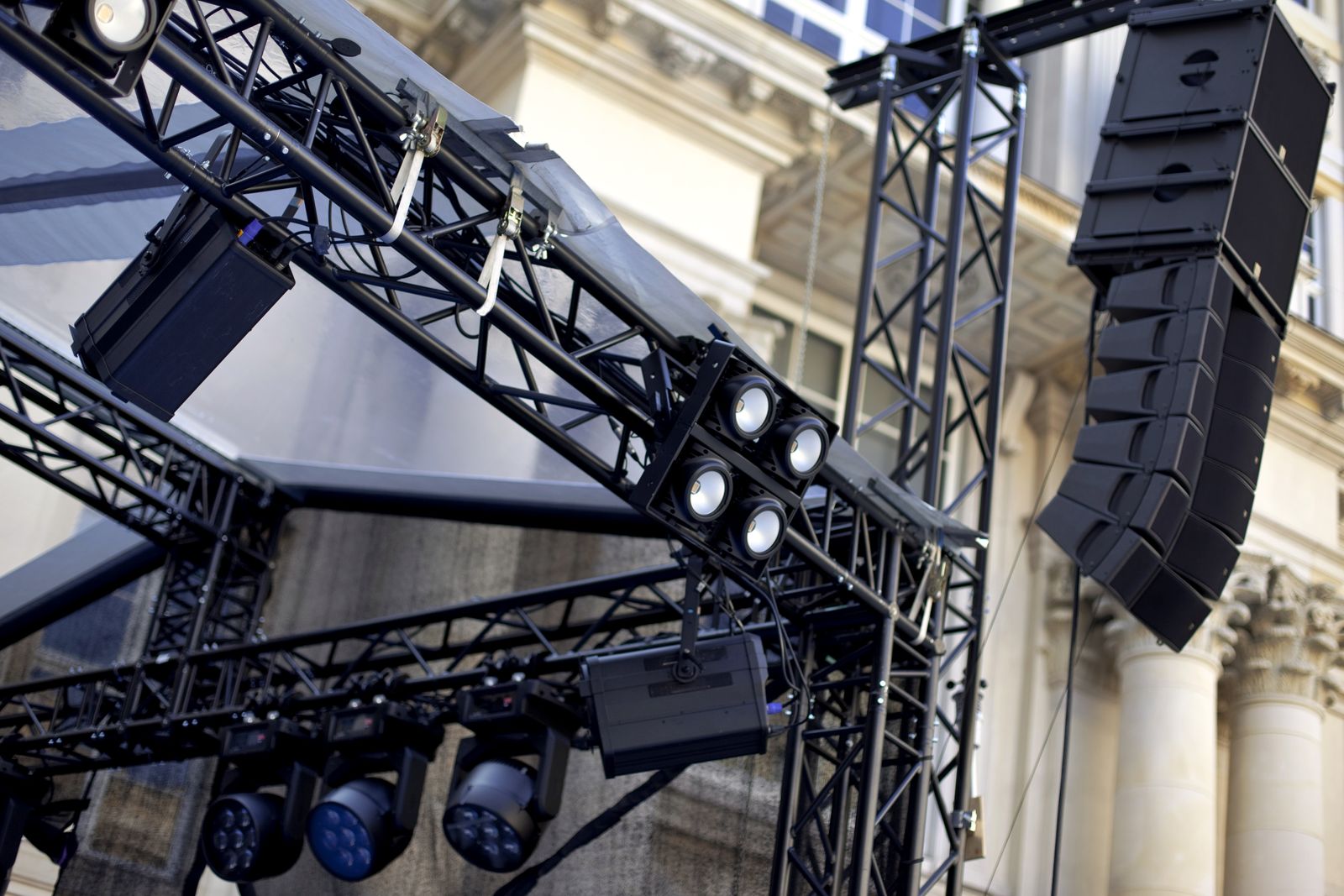
If the event needs front lighting, the truss structure has to be planned from the outset: it affects weight, anchoring and set-up time.
Video
LED screen or projector: they don't compete on the same ground
The right question is not which is better, but how much ambient light there is. A projector with a good projection screen gives a large image at a reasonable cost, but it needs low light: in direct sun or with the room lights on, the image washes out. An LED screen emits its own light and can be seen in daylight, outdoors and with spotlights pointing nearby.
Pixel pitch and viewing distance
Pixel pitch is the spacing between the LEDs. The smaller it is, the sharper the image up close and the more expensive the square metre. The rule of thumb: if the audience will be very close, you need a fine pitch; if they will be at a distance — a concert stage, a side reinforcement screen — a larger pitch is perfectly valid and saves a good deal. Choosing a finer pitch than necessary is the most common overspend in video.
Size and content
Size is decided by the distance to the back row and by the type of content. Small text on slides demands more screen than a video or live camera feeds. If you are going to show presentations at a conference, test the material first: small font sizes and dense charts cannot be read from the back, however high the screen's resolution.
Who feeds the images
A screen without a source is just furniture. You need to decide whether it will show pre-recorded content, presentations from a laptop, live cameras or a mix. If there are cameras, multi-camera live video production comes in, and if the event is also broadcast outside the venue, streaming. All of that is decided before sizing the screen, not after.
Set-up
Time is the variable nobody calculates properly
Site layout
Everything is marked out on the ground: stage, towers, screen, control position and cable runs. Half an hour here saves two hours later.
Structure
The platform is levelled and assembled. This takes the most people and the most time, and almost nothing else can be done in parallel.
Truss, screen and rigging
Everything that goes up high is raised before anyone else arrives, with the area clear and no audience present.
Sound and lighting
Cables are run, speakers are positioned and lights are focused. From this point on, work can continue with the stage occupied.
Testing
Sound, video and lighting, in that order and at real volume. If the test is done with guests inside, it is no longer a test.
Take-down
It is half the job and almost always at night. It is best to agree the departure time when you sign, not when the party ends.
Keep reading
Related equipment
Frequently asked questions
Frequently asked questions
How high does a stage need to be?
It depends on how deep the audience is. With a seated audience and few rows, a low platform is enough. With a standing audience stretching far back, you need more height so that the back row sees the stage and not the heads in front.
Can a stage be set up on albero (compacted sand) or grass?
Yes, it is common in Seville. It requires levelling and, depending on the structure and the expected wind, ballasting or anchoring. It is one of the things worth checking on a prior site visit.
LED screen or projector for my event?
If there is ambient light or it is outdoors during the day, an LED screen. If it is in a room that can be darkened and budget is the priority, a projector with a good projection screen.
Does the screen need a technician?
Yes, someone has to manage the image source during the event: switching from a presentation to video, to cameras or to the holding image. Otherwise the screen ends up showing a laptop desktop in front of two hundred people.
Can I rent just the platform?
Yes. Platforms and stage decks are rented on their own, with set-up included, without having to book sound or lighting.
Tell us about the venue and the audience size
With the venue measurements and the number of guests, we'll tell you what structure you need.
