
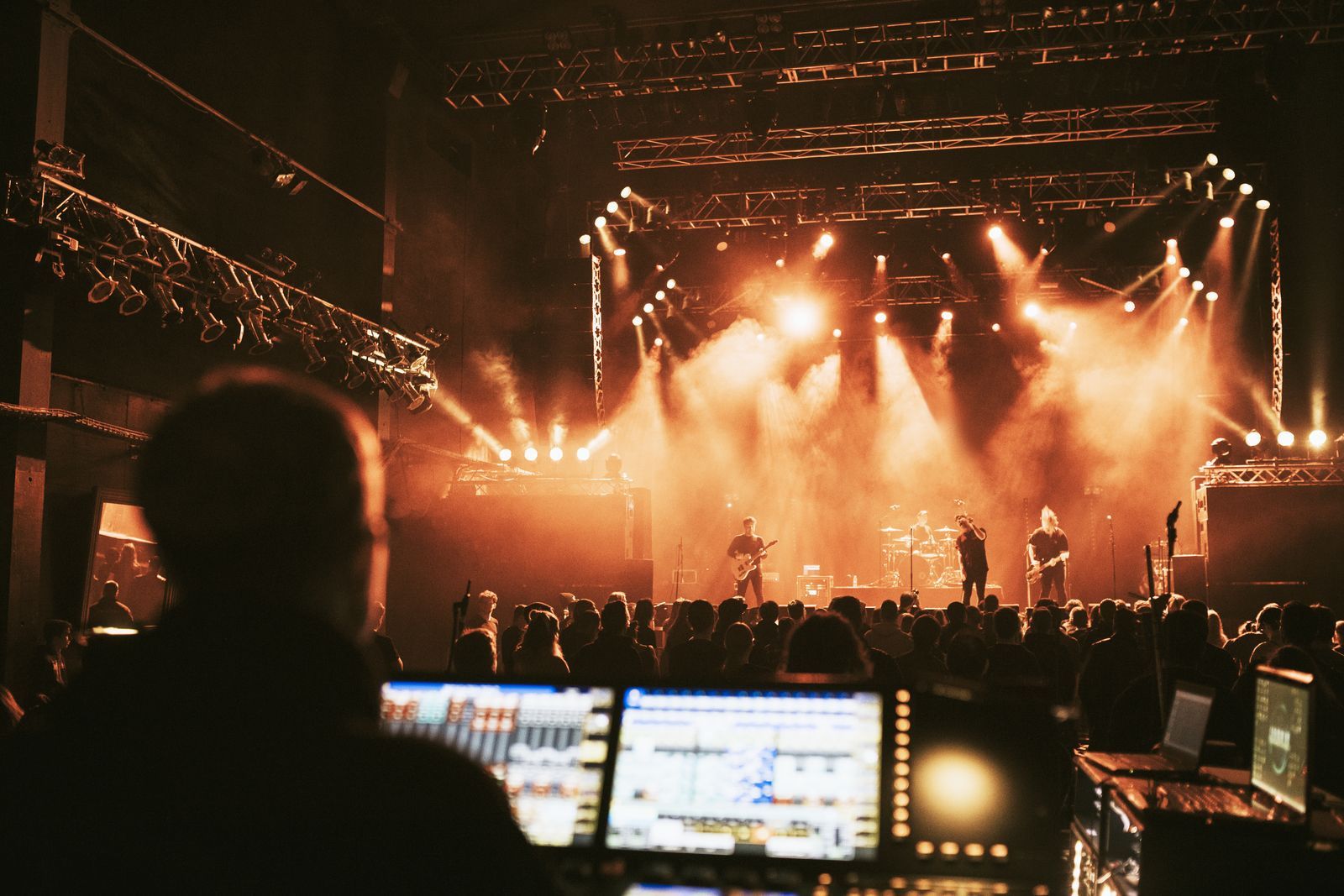
Live shows and festivals
Sound for concerts and festivals in Seville
We read the rider, size the PA for the real audience and set up with enough time for a proper sound check. Without that, a live show is a gamble.
- Format
- From small venues to open-air festivals
- Includes
- PA, monitoring, microphones and technician included in the proposal
- Backline
- On request, per the rider
- Set-up
- With time built in for a sound check
Show day
A live show is eight hours of work for ninety minutes of music
Load-in, structure build, flown or ground-stacked PA, stage cabling, line check, instrument-by-instrument check, band sound check, doors, show and take-down. If any block eats into the next, the sound check is what disappears – and you can hear it.
Read the rider before quoting
The band's technical rider sets out what they need: how many channels, which mics for each instrument, how many monitor sends, whether they bring their own engineer and whether they use in-ear systems. Quoting without reading it is how you end up with a 16-channel desk for a band that asks for 24. If the rider is all Greek to you, we explain it in plain language here: how to read a technical rider without being a technician.
Sizing the PA for audience and space
Power isn't chosen by the number of watts, but by how many people there are, how far away the back row is and whether the space is indoors or outdoors. In a small venue, two boxes a side with subwoofers will do the job. Beyond a certain capacity and distance, the system that gives good coverage is a line array, because it spreads the level evenly and doesn't force you to blast the front row so the back row can hear. Outdoors you have to factor in wind and the lack of walls; in an enclosed town square, the façades bounce everything back.
Monitoring: what the band hears
A concert falls apart because of the monitors long before it does because of the PA. If the singer can't hear themselves, they go off pitch; if the drummer can't hear the bass, they lose the tempo. You need to define how many independent sends are required, whether they're wedges or in-ears, and have the feedback notches set during the sound check – not during the first song.
Backline and stage
When several bands are playing, a shared backline saves hours: one drum kit, guitar and bass amps, and each band only swaps out their own gear. The stage and risers go up before any audio arrives, and if the concert is outdoors in the rainy season, a covered stage is advisable.
Rider and site visit
We read the rider, measure the site and decide where the PA, the mix position and the power supply will go. Without a site visit, we work from photos and measurements.
Structure and stage build
Stage deck, truss and PA towers. Everything at height is installed with ballast or with verified rigging points.
Audio set-up and cabling
PA, subwoofers, monitors, stagebox and stage cabling. Everything is labelled so changeovers between bands are quick.
Line check and band sound check
First we check channel by channel; then the band plays. The tidier the first part, the less time is lost on the second.
Doors and show
The front-of-house engineer mixes the live show; if there are several bands, scenes are saved on the digital desk to recall each configuration.
Take-down
We pack up overnight or first thing the next day, depending on what the venue and its licence allow.
How it is sized
What system each audience size needs
| Situation | PA | Control |
|---|---|---|
| Up to 150 people, indoor venue | Two-way system per side with subwoofers | 16-channel digital desk, 2 or 3 monitor sends |
| 150 to 500, indoor venue or marquee | PA with ground-stacked subwoofers or a compact flown system | 24- to 32-channel digital desk, 4 to 6 sends |
| 500 to 2,000, outdoors | Line array per side with a subwoofer array | Separate front-of-house and monitor mix positions |
| Several bands on the same day | Fixed system plus shared backline | Scenes saved per band and quick changeovers between sets |
What to plan for
Power, noise, permits and rain
Power. A concert doesn't plug into a household socket. You need to know how many kilowatts the venue has available and whether a generator is required – on open ground and at sites with no mains connection, it always is. We go into detail in how many kW you need for an event.
Noise and curfews. On public streets and in places with neighbours there's a finishing time and, often, a sound-level limit. Check this when applying for the permit, not on the night: noise regulations for events in Seville and permits for events on public streets.
Copyright. If there's music, there are rights to manage. It's the organiser's paperwork, but it's better to know in good time: SGAE and copyright at events.
Audience and safety. Separate the stage from the audience with crowd barriers, and if there's a guest area or sightlines are tricky, add grandstands. Live-show lighting and moving heads hang from the truss alongside the PA, so the rigging points are allocated before anything goes up.
Send us the rider and the capacity
With the band's rider, the venue and the site access time, we'll send you back a fixed technical proposal.
Frequently asked questions
Questions from promoters and bands
How many watts do I need for a 500-person concert?
The useful question isn't how many watts but what coverage is needed. The distance to the back row, whether the venue is open-air and the type of music all play a part. We explain it with examples in how much sound power do I need.
The band is bringing their own engineer. Is that a problem?
Quite the opposite. We supply the system set up, tuned and working, and their engineer mixes. We just need to agree beforehand which desk will be used and whether they need to load their own scenes or file format.
How long do you need to set up?
It depends on the size. A small-venue set-up takes a couple of hours; a festival with a stage, flown PA, lights and screen takes the whole day. What you can't do is set up and sound check in the same one-hour slot.
Can you provide sound for several bands on the same night?
Yes, and it's the norm. We set up a shared system, share backline wherever possible and save scenes for each band on the digital desk, so changeovers between sets take minutes rather than half an hour.
What happens if it rains?
Electrical equipment is never left exposed. If the concert is outdoors, a covered stage or marquee is planned in from the quote stage. Calling the show off for rain is the organiser's decision, but how the equipment is protected is decided beforehand.
Do you rent out the equipment only, without a technician?
For small set-ups, yes. As soon as there's a flown PA, multiple monitor mixes or several bands, a technician is essential and is always included in the proposal, even if quoted as a separate line item: it's not a sales add-on, it's what makes the concert sound just as good on song one as on song twelve.
Quote
Get a quote for your live show
Date, venue, expected audience, number of bands and access time. If you have a rider, attach it.
How it looks
Set-ups for this type of event
Examples of the equipment and set-up an event like yours usually needs.
