
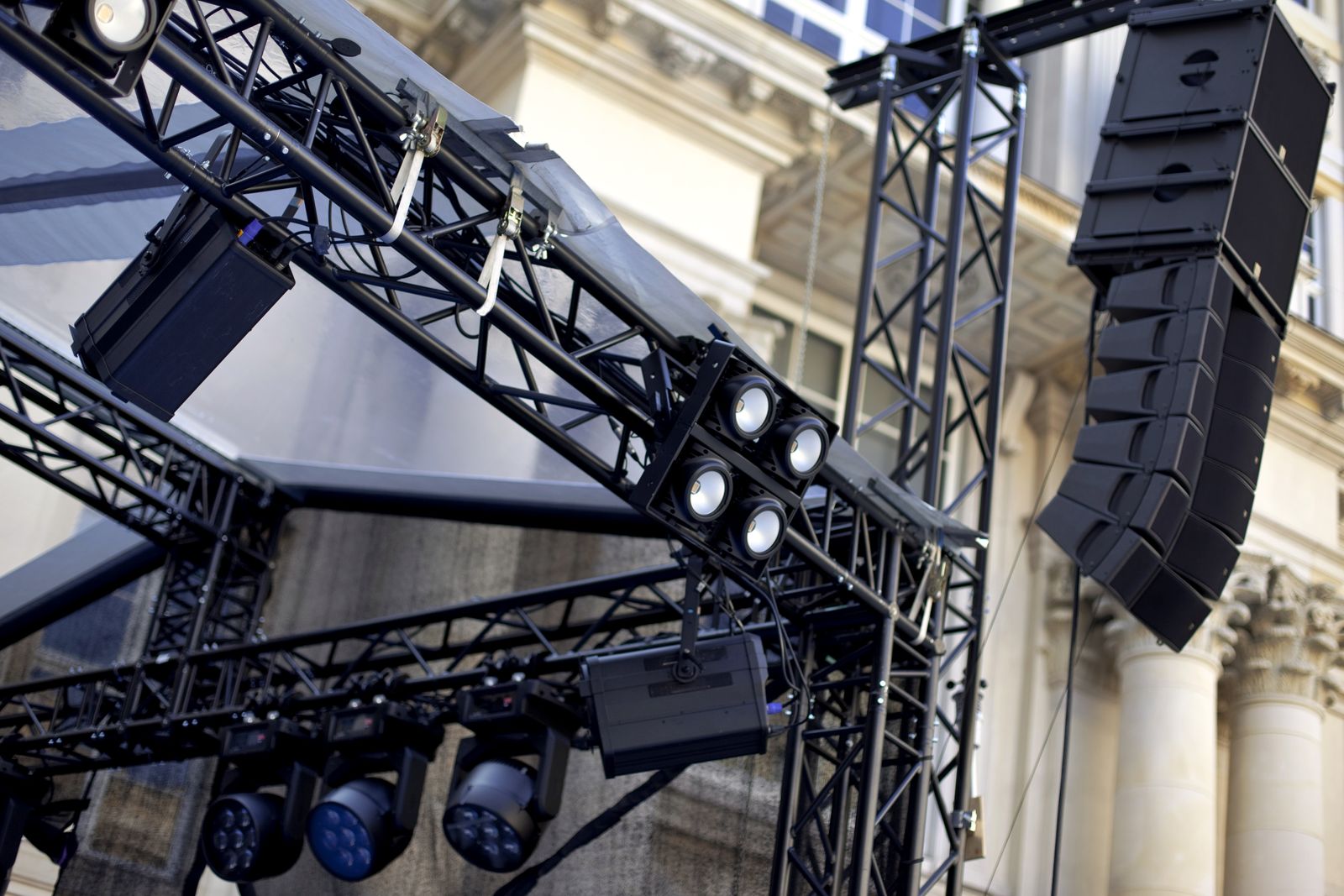
Catwalks
Catwalk rental for fashion shows
A catwalk is a long, narrow riser, and that's where all the difficulty lies: absolute firmness, a flawless finish and lighting that does justice to the clothes.
- Format
- Modules, length and width to measure
- Finishes
- Carpet, white, black or lacquered
- Accessories
- Steps, backstage, lighting
- Set-up
- Included, with levelling
- Area
- Seville and province
What it is
The most demanding riser there is
On a catwalk one person walks alone, in thin heels, eyes forward and unable to look where they're stepping, in front of cameras and an audience a metre away. There's no room for a single module that gives way.
Technically it's a modular riser like the one used at any event, but the tolerances are different. A joint between modules that can be felt under a heel, a millimetre of unevenness or a deck that sounds hollow becomes a problem visible from the front row. That's why on a catwalk we focus on three things above all: levelling, firm joins between modules and a seamless finish.
Decisions to make beforehand
- Length and width. Length is set by the room and the number of passes; width by the look you want and whether more than one model will walk at a time. A narrow catwalk looks better, but is less safe in high heels.
- Height. A raised catwalk gives the models more presence and improves visibility from the back, but it complicates access and the exit step needs careful attention. A low one is safer and more discreet.
- Shape. Straight, T-shaped or L-shaped, depending on where the backstage area and cameras are.
- Finish. Carpet (muffles footsteps and sets the colour), high-gloss lacquer (more spectacular, more slippery and shows footprints more) or a smooth matt surface.
- Exit and backstage. It's the part almost nobody plans, and the one that shows most if it goes wrong.
Sizes
What shapes the installation
| Factor | What it affects |
|---|---|
| Available space | Sets the maximum length and how many guests fit along the sides |
| Number of passes and models | If two models are on the catwalk at once, it needs to be wider and longer |
| Platform height | The higher it is, the better the visibility and the more care needed with access and handrails |
| Type of footwear | Thin heels determine the finish and how firm the joints must be |
| Camera positions | A fixed spot is reserved at the end of the runway, with clear aisles along the sides |
| Backstage | Needs direct access, hidden from the audience, with room for quick changes |
Around the catwalk
Backstage, lighting and sound: the parts of the show nobody sees
The catwalk is the visible half. The other half is a space behind it where outfits are changed against the clock, and lighting that has to stay true to the designer's colours.
Backstage
You need an enclosed area with direct access to the catwalk entrance, lit with neutral light for make-up and with room for clothes rails and changes. It's built with a structure and opaque drapes, or by using an adjoining room. What matters is that the exit onto the catwalk is clean: no improvised steps, and the inside isn't visible when the curtain opens.
Lighting
Fashion show lighting has one rule that can't be broken: it must not alter the colour of the clothes. No saturated colour washes over the runway; colour goes on the backdrop or the walls, not on the garments. The goal is even front light along the whole catwalk, with no dark patches between fixtures and no harsh shadows under the eyes. This is achieved with high-quality white LED lights spread along the runway, with scene changes between passes if the running order calls for it. If there are moving heads, they are usually used to dress the backdrop and for the grand finale, not to light the models.
Sound
The music in a fashion show sets the pace of the walk and the cuts between passes. It needs even coverage on both sides and clean starts: a badly executed fade ruins an entrance. We go into this in more detail in sound for fashion shows in Seville, where we also cover microphones for the presenter and coordination with production.
Common mistakes
What ruins a fashion show
- A catwalk that's too narrow. It looks sleek on camera, but it's a real risk with high heels and long skirts.
- An untested gloss finish. Lacquer looks spectacular and it's slippery. If you choose it, test it with the show footwear before deciding.
- Coloured light on the clothes. A warm amber turns off-white into cream and blue into grey. The designer will be the first to notice.
- An improvised backstage. Without space and order, changes run late and the passes fall out of sync.
- Forgetting the photographers' pit. If there's no reserved position at the end of the runway, they'll be fighting over it mid-show.
- Not rehearsing the walk. Even a quick run-through helps spot a module that moves, an exposed cable or a poorly lit step.
The service
What catwalk rental includes
Layout design
We define length, width, height and shape using the floor plan, the audience position and the backstage location.
Installation and fine levelling
Modules joined together, tight joints and the surface checked by walking it before handover.
Finishes and trims
Carpet or smooth surface, perimeter skirting and edge trims so the structure isn't visible.
Access and steps
A safe, discreet exit from backstage, with whatever step lighting is needed.
Coordination with production
We work to the set-up, testing and rehearsal schedule set by the show's organisers.
Take-down at the end
Full collection the same day or the next, depending on what the venue allows.
What sizes can a catwalk be?
It's built from modules, so the length and width are adjusted to the space and the type of show. What you shouldn't push is the width: a catwalk that's too narrow looks great in photos and is uncomfortable to walk in heels.
Is carpet included?
It can be set up with carpet, a smooth surface or a lacquered finish. Carpet muffles footsteps and adds colour, and it's the safest option. If you want a specific colour, let us know well in advance.
Can it be set up in a hotel or a courtyard?
Yes, that's the most common setting. We need to check access (door and lift widths), the condition of the floor and when the space becomes available. In courtyards and outdoors, more levelling is needed and a plan B for rain should be in place.
Can you also set up the backstage area?
Yes, with a structure and opaque drapes, including neutral lighting for make-up and the exit onto the catwalk. It's worth defining this part of the installation early, as it determines where the runway starts.
How long does installation take?
Less than a large stage, but with more fine-tuning: levelling and finishing are what take the time. We ask for the space to be clear and for time for the organisers to do a test walk before the audience arrives.
Structure
The structure, built
Stages, truss and everything that holds up the sound and lighting.
Planning a fashion show in Seville?
Send us the floor plan or the room dimensions and we'll propose the catwalk, the backstage and the lighting.
