
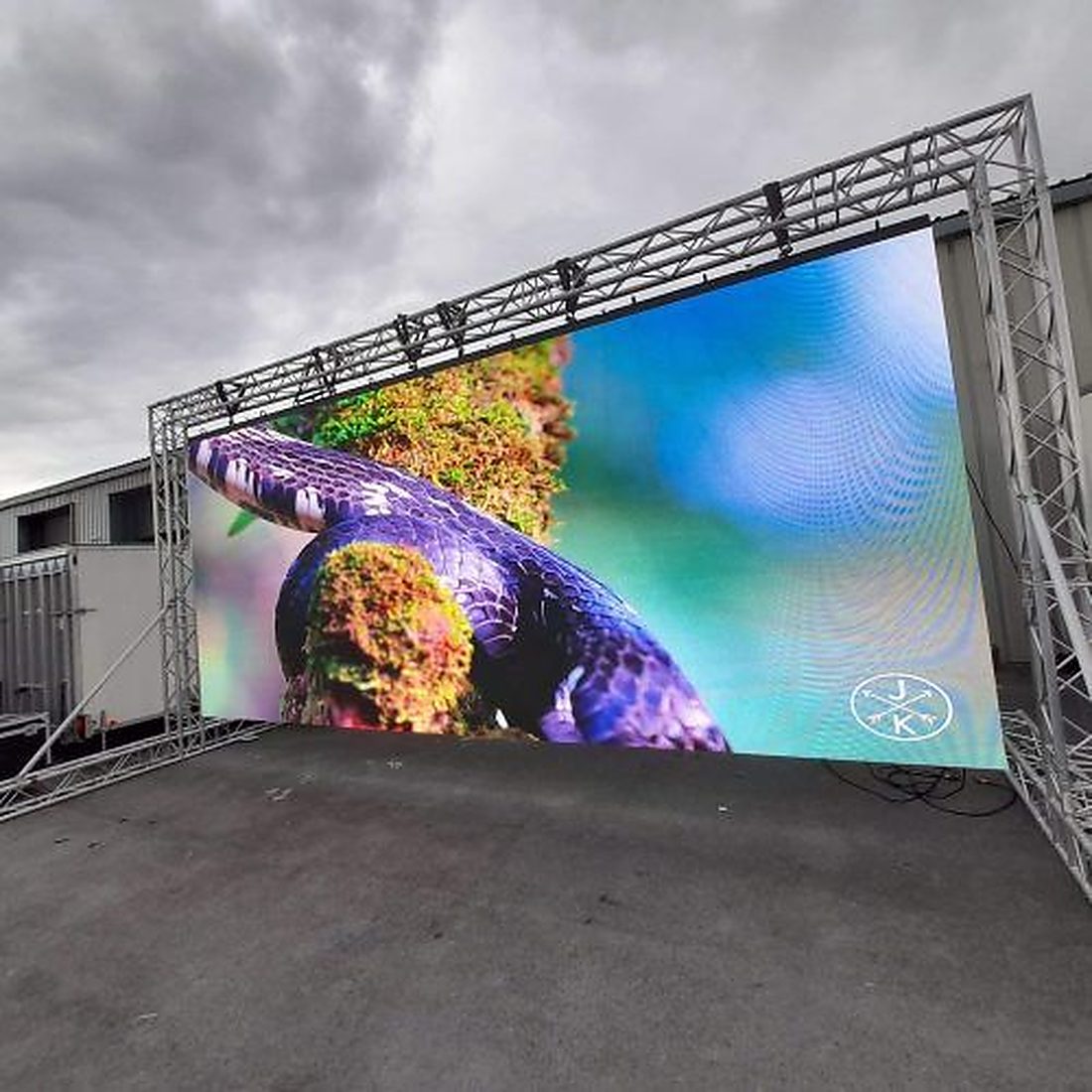
LED screens
LED screen rental in Seville
Modular LED screens for indoor and outdoor use, with a sharp, bright image even in full sunshine. We build the size your space needs, complete with structure and processor. The video technician is quoted separately.
- Use
- Indoor and outdoor
- Format
- Modular, built to size
- Includes
- Structure and processor
- Set-up
- Included
- Area
- Seville and province
What it is and when you need it
A screen you can see in sunlight, at whatever size you want
An LED screen doesn't reflect light: it emits it. That's why it's the only real option in daylight, and why it can be built to any size: it is made of modules that slot together like building blocks.
Why LED rather than projection
A projector throws light onto a surface; if there is more light in the room than it projects, the image washes out and loses contrast. LED emits its own light at far higher brightness, so it holds up in a courtyard at midday, a marquee with open sides or a room with large windows that nobody is going to cover. Indoors with controlled lighting, projection is still cheaper for the same size; in any other setting, LED is what people will actually see.
Modular: the event sets the size
LED screens are built from fixed-size modules that lock together. That means they can grow in width and height almost without limit and break away from standard formats: an ultra-wide screen behind a stage, a vertical one for a stand or a square one for a scoreboard. You choose the aspect ratio, and the content is then prepared for those exact dimensions.
Where we install them
Concerts and festivals, with large screens so the audience can see the artist and to run visuals; weddings and celebrations, for videos and photos of the couple; conferences and corporate events, with presentations and product launches; trade fairs and stands, where the screen is the main draw; and sporting events, with live broadcast and scoreboard.
How to choose
Pixel pitch matters more than anything else
Pixel pitch is the distance in millimetres between two points of light. The smaller it is, the higher the definition and the closer you can look at the screen without seeing dots. The rule of thumb: the pitch in millimetres roughly equals the minimum viewing distance in metres.
| Pixel pitch | Minimum viewing distance | Where it fits |
|---|---|---|
| P2 – P2,6 | From 2 – 3 m | Indoor. Conference rooms, TV sets, stands where people walk right past |
| P3 – P3,9 | From 3 – 4 m | Indoor. Conference stages, presentations, weddings in a banqueting hall |
| P4 – P5 | From 4 – 5 m | Large indoor and covered outdoor spaces. A very common mixed-use option |
| P6 – P8 | From 6 – 8 m | Outdoor. Concerts, town squares, venues where the audience is further away |
| P10 and above | From 10 m | Large-format outdoor. Festivals and big crowds |
Indoor, outdoor and brightness
An indoor screen is not the same as an outdoor one
Brightness: nits, not watts
Brightness is measured in nits (candelas per square metre). An indoor module runs at lower figures because, in a darkened room, high brightness is uncomfortable and blows out the image on camera. An outdoor module needs far more to compete with the sun. Using an indoor screen outdoors is the classic mistake: it looks grey and washed out. The reverse has a cost too: an outdoor screen at full brightness in a banqueting hall dazzles everyone and ruins any recording.
Protection against water and dust
Outdoor modules are sealed and withstand humidity, dust and continuous sun. Indoor ones are not. If the event is in a courtyard, a square or a marquee with open sides, tell us from the start: it determines the module, the structure and the price.
Most requested sizes
Indoors, the usual range runs from 3 × 2 m for a conference room to 5 × 3 m for a large hall. Outdoors, from 4 × 3 m for a verbena (street party) or an event in a town square to 6 × 4 m or more for concerts and festivals. Before settling on a size we check two things: how far away the furthest viewer is and the clear height of the venue.
Structure and processing
What's behind the screen
An LED screen isn't simply propped up on the floor. There is a structure holding it up and electronics telling it what to display.
Support structure
Ground support standing on the floor with ballast, or flown from truss if the venue has rigging points. Outdoors, wind has to be factored in: a screen acts like a sail, and ballast and bracing are not optional.
Height and position
With a seated audience on a flat floor, the bottom of the screen must sit above people's heads. Next to a stage, it is lined up with the height of the platform so the speaker and the screen can be seen together.
Video processor
This is the component that converts the incoming signal to the exact resolution of the assembled screen, scales and crops it, and lets you switch sources seamlessly. No processor, no LED screen, even if nobody ever sees it.
Signal inputs
HDMI for laptops and media players, SDI for long cable runs and for the live production cameras. If the cable runs over twenty metres, it's SDI or fibre.
Tailored content
Video is prepared at the actual resolution of the assembled screen. A logo designed for 16:9 stretched across a 5:1 ultra-wide screen ends up distorted. Send us the files in advance and we'll check them.
Power
Power consumption depends on the screen area and the working brightness. Outdoors, it goes into the generator calculation together with the sound and lighting.
What the rental includes
What's included and what's quoted separately
Modules and structure
The assembled screen, with its support, ballast or rigging and side trims.
Processor and cabling
Video processor, signal runs, power distribution and backup cable.
Transport and set-up
Delivered, installed, aligned and tested before the event. Take-down when it finishes.
Image adjustment
Brightness adapted to the light on site and to whether cameras are recording.
Video technician
Quoted separately, as with all our installations. Always advisable when there are several sources or live content.
Content
We play back and adapt formats; the client supplies the designed material.
Tell us the venue and the time of the event
From the size of the space, the audience distance and the available light, we'll tell you which pixel pitch you need.
Related equipment
What gets installed alongside the screen
Hardly any LED screen goes out on its own. This is what usually comes with it in the same quote.
Frequently asked questions
What people ask before renting an LED screen
Can you see an LED screen properly in direct sunlight?
Yes, as long as it's an outdoor module with enough brightness. That's exactly the situation where a projector won't do. What we do avoid is pointing it straight into the afternoon sun: turning it a few degrees gives the image a lot more contrast.
What size of screen do I need?
It depends on how far away the furthest viewer is and what will be shown. For text and presentations, the screen height should be roughly one eighth of the distance to the back of the room. For video and images you can go a little smaller.
How long does it take to set up?
A medium-sized indoor screen takes about two to three hours, including structure, cabling and calibration. Outdoors, with ballast and bracing, allow half a day. We need access to the venue with that much lead time before the event.
Can I connect my laptop directly?
Yes, it goes into the processor via HDMI. We'll tell you which resolution to set on your laptop so the whole image fits with no black bars. If the cable run is long, we convert to SDI and nothing changes on screen.
Can it be used to show a match or a live event?
Yes. It's standard at sporting events and events with large audiences: the camera feeds go through live production and on to the screen, and the same feed can be streamed online at the same time.
And what if it rains?
Outdoor modules can withstand rain, but the structure and the wind have the final say. If strong gusts are forecast, the screen comes down: it's a huge surface and that's the sensible decision. We discuss it before the date, not on the day.
Quote
Get a price for LED screen rental in Seville
Tell us about the event, the space and what will be shown. We reply within 24 working hours.
Video
Screens, projection and control
The video equipment and the control position it is operated from during the event.
