
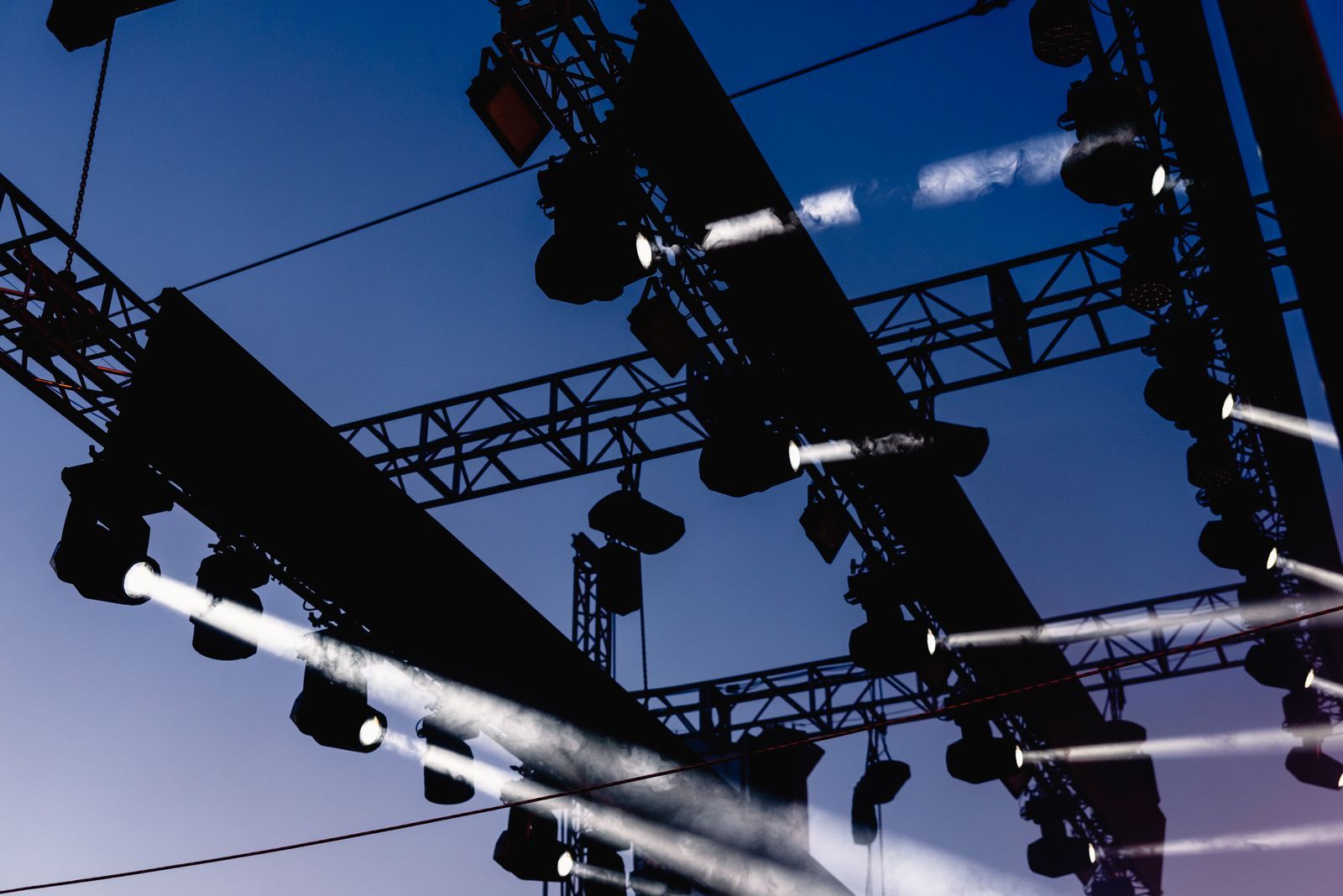
LED lights
LED fixture, bar and wash light rental
The workhorse of any lighting rig: they use little power, add colour and can go almost anywhere. We explain which ones to ask for and how many you really need.
- Types
- LED PARs, bars, RGBW wash lights
- Control
- DMX, remote or standalone
- Power
- Mains or battery
- Set-up
- Included
- Area
- Seville and province
What it is
An LED fixture isn't a coloured light bulb
Inside an LED PAR there are dozens of diodes in several colours that blend to produce a specific shade. That's where the impossible greens and warm ambers that a normal lamp can't produce come from.
The practical difference from old-style lighting is threefold: it uses far less power, it doesn't heat the space and it changes colour instantly without gel filters. That means you can add colour at a country estate without overloading the electrics, and the ceremony lighting and the party lighting can come from the same fixture.
RGB, RGBW and RGBWA+UV: why the letters matter
An RGB fixture mixes red, green and blue. It gives great saturated colours, but its white is weak and muddy. An RGBW adds a dedicated white diode: it produces the same colours plus a clean white and convincing pastels. If you're lighting a white or beige hacienda wall, or want champagne and amber tones, the dedicated white makes all the difference. Those that add amber and UV refine warm tones even further, as well as blacklight effects.
Beam angle: wash or spot
The same fixture with a narrow lens draws a small, powerful circle; with a wide lens it washes a large surface in soft light. A wash light is designed for the latter: covering a wall, a drape or a façade evenly. An LED bar is a strip of independent segments: it works as a wash, as a line of colour along the front of a stage or as a backlight. Choosing the wrong angle is the most common mistake: the right fixtures, placed at the wrong distance, leave patches and harsh shadows.
Variants
Which to ask for depending on what you want to light
| Type | What it is | What it is for |
|---|---|---|
| LED PAR | Compact medium-beam fixture | Accent colour, backlighting, lighting a specific area |
| Wash light | Wide, even beam | Walls, drapes, façades, stage backdrops |
| LED bar | Strip of independent segments | Stage fronts, lines of colour, segment effects |
| Battery uplight | Standalone floor fixture | Uplighting at weddings and in halls with no visible cabling |
| Profile spot | Beam that can be shaped with shutters | Lighting a lectern, a painting or a logo without spill |
| Blinder | Direct white light onto the audience | Key moments in live shows and parties |
The star set-up
Uplighting: why it looks so good and costs so little
Placing fixtures on the floor right against the wall, pointing upwards. It's the technique that transforms a space most for the least money, and it works just as well in a hall as in a courtyard.
A hall with pale walls and ceiling lights looks bland in every photo. With a row of fixtures washing those walls in a warm tone, the same hall looks like a different place. The trick comes down to three things: setting the fixture just far enough from the wall for the beam to open without burning out the bottom, spacing the points evenly and choosing a single colour. The set-up that ruins the result is the rainbow: every fixture in a different shade turns the wall into a funfair.
Mains or battery
Battery uplights go wherever you want without hunting for a socket or running cables across walkways. They're the logical choice in banquet halls, courtyards and spaces with delicate floor tiles. On the other hand their run time is limited, so you have to count the real hours of the event (set-up included) and not switch them on in the middle of the afternoon «to test them». Mains-powered ones don't have that limit, but they need extension cables and cable ramps planned in advance. At weddings we usually mix them: battery in the guest area, cable where it can't be seen.
If you're planning a wedding, we go into detail on where each point goes and which shade to choose in decorative wedding lighting.
Common mistakes
What people get wrong with LED lights
- Asking for «some lights» without saying what's being lit. The number comes from the surface area and the distance, not from a hunch. Four well-placed fixtures do more than ten scattered at random.
- Putting the fixture too close to the wall. You get a bright triangle at the bottom and the rest stays dark. It needs to be moved back and sometimes tilted.
- Mixing colours on a whim on the same surface. One shade per area. If you want contrast, make it between different areas, not between neighbouring fixtures.
- Forgetting functional light. A beautiful hall in blue where nobody can see their plate. Colour decorates, but the table and the lectern need white.
- Getting the battery life wrong. Switching the batteries on four hours before anyone arrives is the quickest way to be left in the dark during the dancing.
- Confusing watts with light. Two fixtures with the same power draw can differ hugely in colour quality and output. That figure on its own tells you very little.
The service
What the rental includes
Tested equipment, positioned and adjusted, not a box left at the door.
Positioning and colour adjustment
We go point by point setting shade and intensity until the whole thing is even.
Cabling and protection
Extension cables of the right gauge, cable ramps wherever people cross and loads spread across circuits to avoid overloading.
Charged batteries and tested control
If the set-up runs on battery, it leaves the warehouse at 100 % with the remote paired and tested.
Spares on large set-ups
A fixture can fail. On larger installations backup equipment travels with us so it can be swapped without any drama.
Booked together with
What it pairs with
LED fixtures are the foundation; the rest depends on the type of event.
How many LED lights do I need to light a hall?
It depends on how many metres of wall you want to wash and how far away you can place them. With the approximate measurements of the space and a photo, we'll give you a specific number. What doesn't work is scattering fixtures around with no plan: it's better to cover one wall well than four badly.
Do battery-powered lights last all night?
They last a normal event day if they're switched on at the right time and not run at full white, which is the most power-hungry mode. We programme them to come on at the right moment and, if the event is very long, we combine them with mains-powered points.
Can I choose the exact colour?
Yes, and it's best to do it beforehand. If you have a reference (the invitation, the flowers, your corporate colour), we'll match the shade during set-up. Bear in mind that the wall colour changes the result: amber on a beige wall and on a white wall don't look the same.
Can LED lights be used outdoors?
With weatherproof fixtures, yes. In gardens and courtyards you need to protect connections, raise the points wherever there's irrigation or damp, and remember that light gets lost outdoors: you need more output for the same effect.
Do I need a DMX desk for just a few lights?
Not always. For a fixed colour a remote is enough. A desk makes sense when you want different scenes for different moments of the event, or when the rig already includes moving heads and it's best to control everything together.
The lighting
What the lighting looks like once it's rigged
Fixtures, truss and effects, hung and focused before anyone walks in.
Shall we tell you how many lights you need?
Send us a photo of the venue and the approximate measurements and we'll suggest how to lay out the points.
