
Structures
Truss and lifting tower rental
The backbone of the set-up: what holds up the lights, the speakers, the screen and the banner. It is the part of the rental where safety allows no shortcuts.
- Equipment
- Aluminium truss
- Lifting
- Lifting towers
- Uses
- Lighting, sound, screens, banners
- Set-up
- Our own crew, always included
- Area
- Seville and province
What it is
Truss: aluminium, triangles and a lot of physics
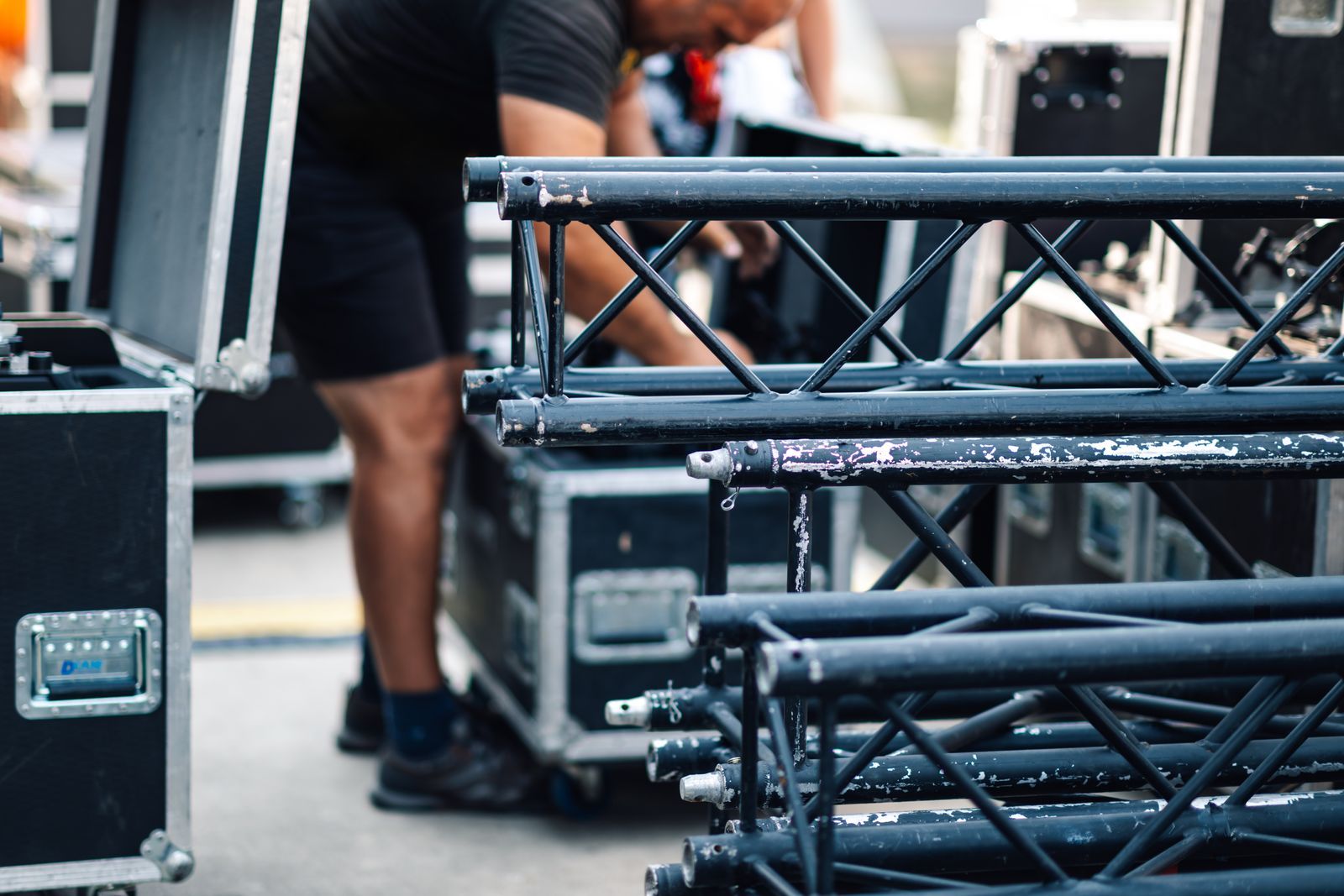
A truss is a lattice of aluminium tubes welded into triangles. That geometry is what allows a lightweight structure to carry loads that a solid tube of the same weight could not.
It is made in sections joined together with conical couplers and pins or with bolts, and combined with corners and bases to form goalpost frames, grids or towers. You will see it at any event: it is what the lights hang from above a stage, what holds an LED screen and what forms the finish arch at a fun run.
The formats in use and what they are for
- Two-tube (flat/ladder) truss: lightweight, for small loads and short spans. Typical for decorative fronts and backdrops.
- Triangular truss: three tubes. A good balance between weight and strength, widely used for hanging lighting on medium-sized set-ups.
- Square truss: four tubes. The one used when there is a serious load, large fixtures or a screen, or when the span between supports is long.
- Lifting towers: telescopic masts with a crank or winch that raise the truss to working height. They have stabiliser legs and need ballast.
The choice is not about looks. It depends on the span (the distance between supports), the weight you are going to hang and whether the set-up is indoors or outdoors. The same truss can be more than enough for a three-metre span and clearly insufficient for eight.
When you need one
Signs that your event needs a structure
It is not always necessary. These are the situations where it is.
You want light from above
As soon as the lights have to be above people's heads, you need something to hang them from. Tripods have a very clear limit.
Sound has to be flown
A line array is designed to be flown; that is the whole point. No rigging point, no array.
You are adding an LED screen
LED screens are heavy and need a structure to support them and keep them flat.
The venue has no rigging points
Marquees, gardens, squares and open-plan warehouses: if there is nothing to hang from, you have to bring the structure.
You need a branded gantry
Finish arches, photocalls, venue entrances or backdrops with a printed banner.
The stage needs a roof
A roof over the stage is a structure through and through, wind load calculations included. We cover it under covered stage.
Safety
Why we don't rent out truss for you to put up yourself
It is the question we are asked most, and the answer is always the same. It is not a sales policy: a badly assembled structure falls, and it falls on people.
A truss does not behave like just any beam. It can carry an enormous amount if certain conditions are met: the load is distributed rather than concentrated, the sections are oriented as the manufacturer specifies (a triangular truss does not carry the same load the right way up as upside down), every joint has all its pins and clips, and the towers are level, ballasted and have their legs fully deployed. Changing just one of those things can reduce capacity to a fraction.
What we do on every set-up
- Calculate before we arrive: we know the weight of what we are going to hang and choose the profile and the number of supports accordingly. It is not decided on site with whatever happens to be on the truck.
- Check the ground: albero (compacted sand), grass, staging or tiled floors do not bear a loaded leg in the same way. On soft ground the pressure is spread with base plates.
- Ballast and brace: especially outdoors. A structure with a banner or flags is a sail; wind is the factor that most often forces a set-up to change.
- Safety cable on every hanging fixture: in addition to the clamp. Always.
- Check where the public will walk: if people pass underneath, the precautions change, and sometimes the position does too.
- Monitor the set-up until take-down: nobody adjusts or “just moves” the structure a little without us checking it afterwards.
Add to this that raising and lowering a loaded lifting tower has its own technique, that the equipment is inspected after every event and that our public liability insurance covers set-ups carried out by our own staff. That is why structure installation is always included and the equipment is never handed over on its own.
How it is sized
The information we need
| Factor | Why it affects the set-up |
|---|---|
| Span between supports | The longer it is, the bigger the truss section or the more intermediate supports |
| Load to be hung | Lights, moving heads, sound, screen, banner: everything is added up, cabling included |
| Load distribution | Spread along the section, not concentrated in the middle |
| Working height | Determines the tower model and the space needed to raise it |
| Indoors or outdoors | Outdoors, wind, ballast and the weather forecast come into play |
| Ground type | Albero, grass, concrete or staging: it changes how pressure and ballast are distributed |
| Public access | If people are underneath, the position and protections change |
The service
What truss rental includes
- A study of the set-up with the actual loads you are going to hang.
- Truss, corners, bases, lifting towers, ballast and fittings.
- Transport, set-up and take-down by our own crew.
- Safety elements: pins, clips and steel safety cables for every fixture.
- Coordination with lighting, sound and video, so everything is hung in the same order and on the same schedule.
- Dressing the structure with skirts or banners when the event calls for it.
If the set-up includes a platform, it makes sense to book the stage or risers at the same time: the structure and the platform are planned together, not one on top of the other at the last minute.
How much weight can a truss hold?
There is no single figure: it depends on the profile, the length of the span, how the load is distributed and how it is supported. That is why we ask what you are going to hang before telling you what structure we will build, rather than giving a generic figure that would mean nothing.
Can you put up truss in a garden or on albero?
Yes, it is common at country estates and village fairs. The ground has to be levelled, the pressure from the legs spread with base plates, and more ballast used than on concrete. We also check that there are no sprinklers, inspection chambers or roots right where each support goes.
Do I need a permit to put up a structure in the street?
For set-ups on public roads, the local council usually requires paperwork and a permit to occupy the space. The event organiser handles it; we provide the technical data for the set-up. On our blog we explain how permits for events on public roads work.
What happens if it is windy on the day of the event?
We monitor the forecast from several days before. Depending on what it says, we add ballast, remove banners and flags (which act as sails) or decide not to raise the structure. It is a technical decision we make, and it sometimes means rethinking the set-up on the spot.
Can I rent just the equipment without installation?
For structures, no. Installation and load calculations are part of the service and of the responsibility we take on. A badly assembled truss gives no warning before it fails.
How long does it take to put up a structure?
Considerably longer than most people imagine, especially the setting-out and the lifting. We need the space clear and accessible by truck, and we need to know when the other suppliers are arriving. It is the first thing to agree with the venue.
The lighting
What the lighting looks like once it's rigged
Fixtures, truss and effects, hung and focused before anyone walks in.
Tell us what you need to hang
With the weight, the height and the distance between supports, we will tell you what structure you need and how it is installed.
