
Pillar guide · Seville
The complete guide to sound rental in Seville
What you can rent, how to size it, what pushes up a quote and in what order to lock things down. If you only read one article on the blog, make it this one.
- Reading time
- 9 minutes
- Level
- For organisers, not technicians
- Area
- Seville and province
Starting point
Renting sound means making six decisions, not buying boxes
When someone calls asking for “a sound system for 150 people”, what they are really asking is for someone else to make six decisions for them: how much sound pressure is needed, how it is spread across the space, who will speak and with which microphone, where the power comes from, who sets up and at what time, and what volume limit will be imposed. The equipment is the result of those six answers, not the other way round.
That is why two quotes for the same event can look similar on paper and differ greatly in the result. One has counted the guests; the other has counted the guests, checked whether the venue is an echoey courtyard, asked whether the ceremony is outdoors and allowed for the limiter kicking in at eleven at night.
The questions we ask before giving a price
They are always the same and in this order: date, town and venue, number of guests, exactly what happens (speeches, recorded music, live band, projection) and set-up schedule. With that, almost everything can be sized. Whatever is missing — access, stairs, available power, whether there is a limiter installed — is sorted out with two more questions or a site visit.
If your event is of a clearly defined type, go straight to its page: there is one for weddings, one for conferences, one for concerts and festivals and one for Feria casetas. That is where the specific detail is; here, the general approach.
The equipment
What you actually rent and what each item is for
A sound system is not a box: it is four different functions that can be covered with more or less equipment depending on the event.
1. What projects the sound: speakers and subwoofers
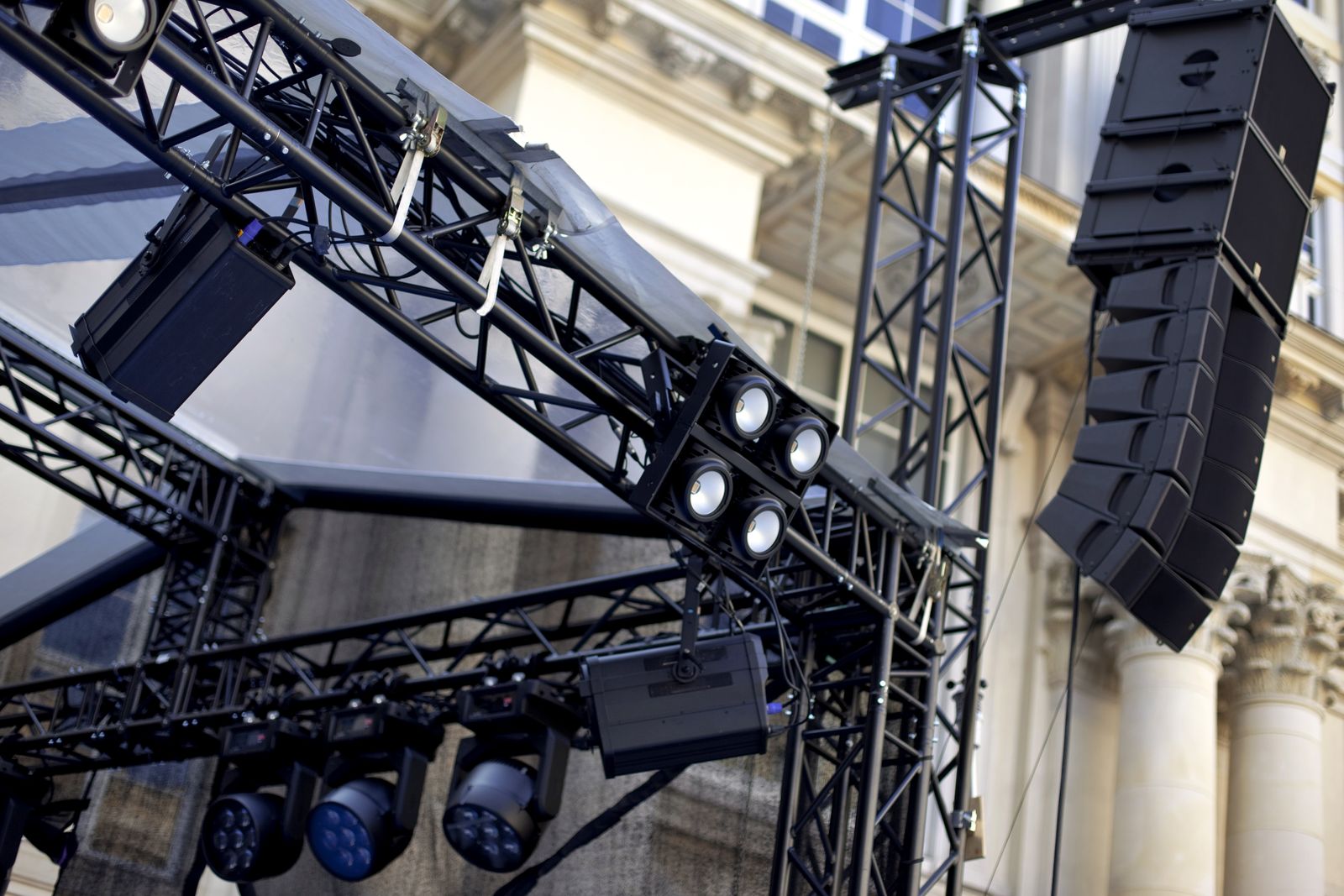
The speakers are the visible part. For small and medium audiences, two well-positioned active speakers on tripods will handle almost anything. When the audience grows, the crowd is further away or the space is long, you move up to a line array, which spreads the sound far more evenly between the front row and the back. Subwoofers are added when there is dance music: without them the system sounds correct but flat, and people don't come onto the dance floor.
2. What picks up the sound: microphones
More events go wrong here than anywhere else. A badly picked-up speech ruins an entire wedding, however good the equipment. There are handheld microphones for presenters, lavalier and headset mics for anyone who needs their hands free, and wireless systems when the speaker moves around. Indoors with a low ceiling, every unnecessary open microphone is feedback waiting to happen: we explain this in the feedback guide.
3. What mixes: consoles and processing
The mixing console is where the balance is decided. For an event with two microphones and background music, a small desk is enough. For a live band you need channels, sends to stage monitors and a digital console that can store scenes between soundcheck and show.
4. What plays back: sources
If there is a DJ, a DJ booth with CDJs or an all-in-one system is the standard. If it is a band, you need to talk about backline. And if it is a party where people sing, karaoke comes into play. For official ceremonies and announcements, what is often needed is not a PA but a public address system: clear voice, low power and wide coverage.
Sizing
How much equipment you really need
The question we hear most is how many watts. It is the wrong question, although it is easy to see why people ask it: it is the only number on the spec sheets. Watts measure what the power amplifier draws or delivers, not what you hear. Two speakers with the same rated power can differ by fifteen decibels depending on their sensitivity and directivity.
What does work as a rule of thumb: the audience size sets the order of magnitude, the space sets the distribution and the type of music sets the headroom. A 200-person cocktail reception with background music needs less system than a 200-person party with a DJ until three in the morning, even though the numbers are identical. And outdoors there are no walls to reflect energy back: the same system that is more than enough in a function room falls short in a garden.
The full explanation, with a rough table by audience size and indoor/outdoor, is in how many watts of sound do I need?. If you would rather not go into the detail, the fixed packages already come sized by audience band.
The costliest mistake: sizing for the wrong moment
Many people size for the moment with the most people and forget the most difficult moment. At a wedding, the critical moment is not the open bar: it is the ceremony, where words spoken softly have to be understood, often outdoors and in the wind. At a conference it is not lunch: it is the panel discussion with four microphones open at once. That moment is what decides the equipment.
Everything around the equipment
Power, set-up, regulations and the things you don't see
Electricity
A medium-sized system does not need a special power supply, but it does need a stable circuit kept separate from the kitchen. Outdoors or at country estates there is almost always a generator. How to add up power consumption and why you oversize is covered in this guide.
Set-up schedule
It is what affects the price most and what people mention least. Setting up in the morning in an empty venue does not cost the same as setting up at seven in the evening with guests arriving, or taking down at four in the morning.
Volume limit
Many venues in Seville have a limiter installed, and others require one before authorising the activity. It is worth knowing in advance: we cover it in sound limiters and in the noise regulations guide.
With or without a technician
A simple system can be delivered set up and explained. As soon as there are several microphones, a live band or changes during the day, the sound technician stops being an extra and becomes the part that makes it all work.
Space and acoustics
A courtyard with a marble floor and bare walls throws back everything you send into it. There, the answer is not to turn it up but to turn it down and bring the speakers closer to the audience, spreading them across more points.
Plan B
Rain, a power cut, a microphone failing in the middle of a speech. A professional set-up includes a spare microphone, extra cabling and an alternative music source. It costs no more and it saves the night.
Price and lead times
What pushes up a quote and when you should call
A sound quote is made up of equipment, logistics and staff. The equipment is usually the least flexible part; logistics and staff are what explain the differences between offers. Transport, set-up time, number of technicians, hours on site and take-down time move the price far more than adding one more speaker. The breakdown is in what sound rental includes and what it doesn't, and the price ranges by type of set-up are in prices and quotes.
On lead times: in Seville the calendar is not evenly spread. The Seville April Fair (Feria de Abril), May with its May Crosses and romerías (pilgrimage festivals), First Communion parties, the two wedding peaks and December pack most of the year into a few weeks. On those dates it is not about negotiating the price, it is about there being any equipment left. The real lead times are in how far in advance to book.
Where we work
We set out from Seville city and cover the whole province: Triana, Nervión, Dos Hermanas, Alcalá de Guadaíra, the Aljarafe or the towns of the Campiña. Travel and how it is calculated are explained in service areas.
Keep reading
Where to go next, depending on what concerns you
More articles from the blog
Frequently asked questions
What people ask us on the phone
Can I rent just the equipment and set it up myself?
For simple systems, yes: a pair of speakers on tripods, a small desk and microphones are delivered set up and explained. For line arrays, truss, stages or any work at height, we do the installation ourselves for safety reasons and because the result depends on how the system is tuned.
How long before the event do you need to set up?
It depends on the size. A two-speaker system with microphones is set up and tested in under an hour. A stage with a line array, monitors and lighting takes up a good part of the morning. What you should never do is set up with the guests already inside: the soundcheck can no longer be done at real volume.
Do I need a technician for the whole event?
Not always. If there is a single delicate moment — a ceremony, some speeches — followed by music only, we can cover just that slot. If there is a live band, several microphones or configuration changes, the technician stays all day.
Do you work outside Seville city?
Yes, throughout the province. Our service areas page lists the towns where we set up most often and how travel costs are calculated.
What happens if it rains?
Outdoors, the equipment is protected or removed; sound equipment and water do not mix. That is why, for outdoor events, it is wise to have the alternative plan decided in advance, and to know whether a marquee or a covered stage is available.
Tell us about your event and we'll tell you what you need
Date, venue and number of guests. With those three details we can already advise you over the phone.
