
Large-format PA
Line array rental for large venues
When the venue is long or the audience goes beyond a few hundred people, two speakers on tripods no longer reach. A line array carries the sound over distance without blasting the front row.
- Format
- Flown or ground-stacked
- Set-up
- Always by our own crew
- Includes
- Subwoofers and processing
- Technician
- Essential: always included in the proposal
- Area
- Seville and province
What it is
Why a line array and not just more speakers
The difference isn't that it's louder: it's that the sound reaches someone ten metres away and someone fifty metres away in much the same way.
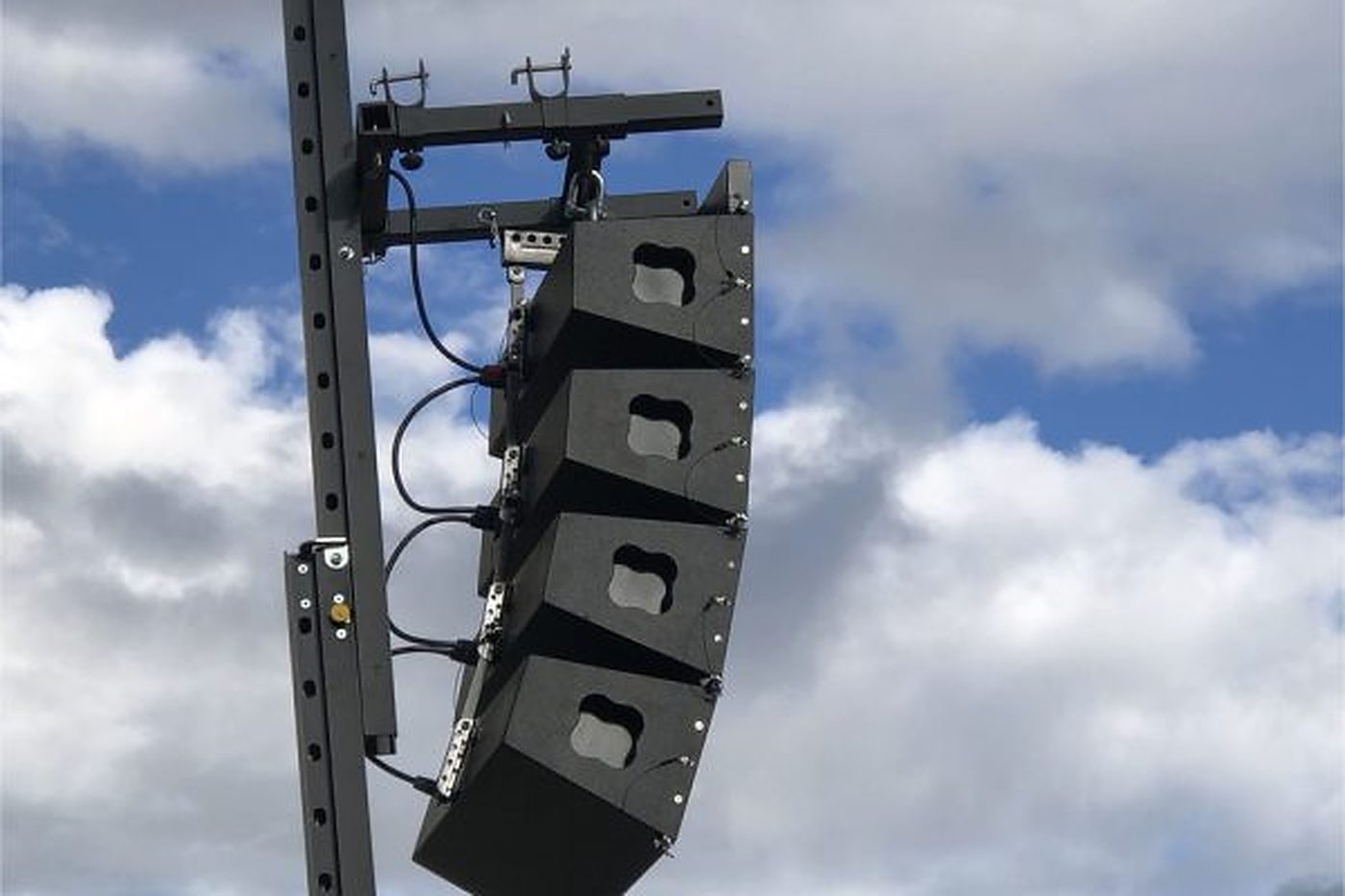
A conventional speaker loses level quickly with distance. If you turn it up to reach the back, you flatten the people at the front. A line array is a column of coupled cabinets working as a single elongated source: the drop in level over distance is much gentler and the vertical coverage can be adjusted cabinet by cabinet, angling each module towards its own section of the audience.
That gives you two things that are very valuable in a large venue: even coverage (the volume doesn't change depending on where you stand) and control over sound spilling upwards and sideways, which is exactly what bothers the neighbours and triggers noise readings.
When you really need one
- Audiences of several hundred people or more, especially outdoors.
- Long venues: squares, avenues, open esplanades, fairgrounds and deep courtyards.
- Concerts and festivals where the band's rider calls for a system with processing and coverage prediction.
- Venues with neighbours close by, where you want the sound aimed at the audience and not at the fourth floor across the street.
When it isn't worth it
For a 120-guest wedding, a caseta (fair marquee) or a function room, a line array is money down the drain and usually sounds worse than a well-positioned conventional system: it needs distance to "form". In those cases you're much better off with well-distributed speakers and subwoofers.
Configurations
How a large-format system is set up
Flown (suspended)
This is the best option when there's a structure to hang from: the system sits high, coverage is clean and the front rows don't have a stack of speakers a metre away. It requires truss or towers, load calculations and certified rigging.
Ground-stacked
The cabinets are stacked on the subwoofers or on a base. It's quicker to set up and needs no structure, but the throw is shorter and the front row gets more level. Suitable for medium-sized venues.
Subwoofers on the ground
They almost always go on the floor, and where they're placed completely changes the result: grouped together they give more punch in the centre; spread out they give more even bass across the whole venue.
Delays and fill speakers
In very long venues, intermediate delay towers are added so the sound at the back arrives in sync with the sound from the stage instead of as an echo.
Processing and measurement
The system is tuned with a processor and on-site measurement, not by ear. That's what separates a professional set-up from a pile of speakers switched on.
Front-of-house control
At live shows, the mixing desk goes in the middle of the audience, not beside the stage. You hear what the audience hears.
What to plan for
A line array can't be improvised on the day
Structure and safety
Flying a system means loads of hundreds of kilos on a structure. That has to be calculated, documented and rigged by trained staff, with slings, secondary safeties and checks before anything goes up. If the event uses a modular stage or a covered stage, the system and the structure are planned together from the outset, not once you arrive at the venue.
Power
A large-format PA with lighting and a screen won't run off a garden socket. You need to know which distribution board it's fed from, with what protection and what cable rating, and if the venue doesn't have one, plan for a generator. The maths is in how many kW you need.
Timings and access
Set-up is normally done the day before or first thing in the morning, with the truck parked right by the stage. If access is via a pedestrian street with restricted hours, the whole plan changes. The sooner we know, the better the event day goes.
Noise and permits
On public roads and at open-air venues there are usually conditions on sound levels and hours. It's worth checking the noise regulations for events in Seville and the permits required before you finalise the line-up, not afterwards.
Reference
How we size the system
With the site plan or exact location we fine-tune the proposal and calculate coverage before we go.
| Situation | System | Planning |
|---|---|---|
| Up to 500 people, compact venue | Ground-stacked system with subwoofers | Same-day set-up |
| 500 – 1,500, square or esplanade | Line array, ground-stacked or flown on towers | Set-up the day before recommended |
| Over 1,500 or a very long venue | Flown line array with delay towers | Set-up the day before and front-of-house control |
| Stage with a band rider | System and processing to specification | Sound check with the band |
Equipment that goes with it
A large system never travels alone
Alongside the PA, people almost always order monitoring, a mixing console with enough channels, stage microphones and a structure.
Frequently asked questions
Questions about line arrays
How many people do you need before a line array makes sense?
It's not just about numbers, it's about distance. With the audience more than 25 or 30 metres from the stage, or with crowds of several hundred outdoors, a line array starts to pay off. Below that, a well-distributed conventional system is usually better.
Can you fly it anywhere?
Only where there's a structure calculated for it: our own truss, PA towers or venue rigging points with certified capacity. If there isn't one, we ground-stack it. We never hang from anything whose load rating isn't proven.
Is the sound technician included?
The technician is always quoted as a separate line item, never hidden in the equipment price. The point with a large-format system is that a technician is essential (tuning it requires measurement and on-site decisions), so it's always part of the proposal: we never hand over a line array without an operator. You can see how it works under sound with technician.
The band has sent me a rider. Can you cover it?
Send it over and we'll tell you what we can cover as specified, what we'd replace with an equivalent and what would need to be sub-hired. If it's all Greek to you, here we explain how to read a technical rider.
How long does set-up take?
It depends on the size and access, but a flown system with a structure takes up a good part of a working day between rigging, cabling, tuning and testing. That's why it's usually set up the day before.
Equipment
The equipment, set up and cabled
This is the equipment this page talks about, and how it looks once it is set up.
Got a large venue that needs sound?
Send us the location, expected audience size and schedule. We'll calculate the coverage and propose the right system.
