
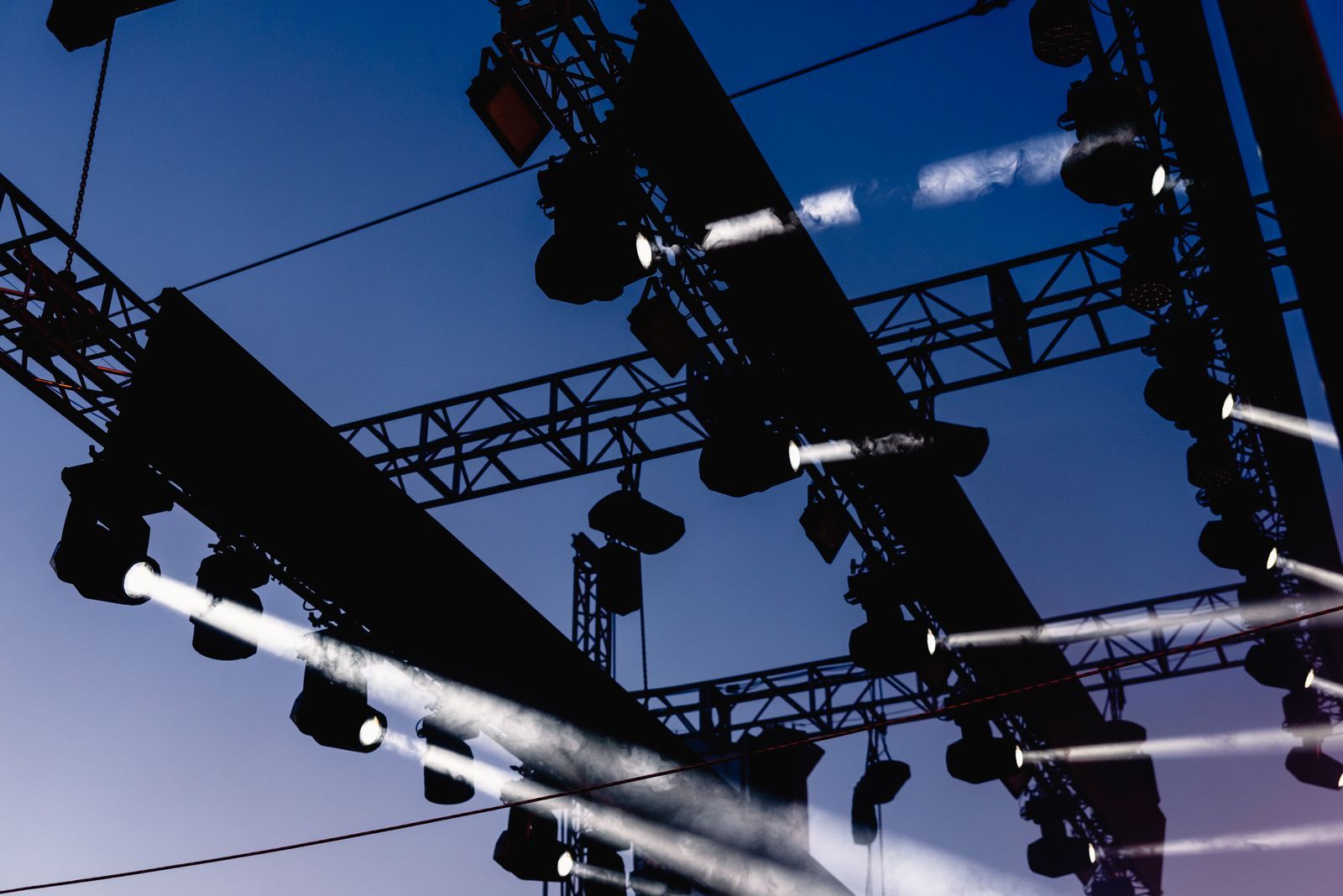
Covered stage
Covered stage rental with roof and side panels
For when your event is outdoors and you can't let the sun, rain or wind make the decisions for you. Here the structure is no longer just support: it becomes a matter of safety.
- Components
- Platform, roof, side panels, skirting
- Stability
- Ballast and bracing
- Key factor
- Wind and weather forecast
- Set-up
- Our own crew, always included
- Area
- Seville and province
What it is
A roof is not a tarpaulin on four poles
A covered stage is a platform with its own structure on top that supports the roof, the side panels and, almost always, the lighting and sound. It is an engineered whole, not an add-on.
The roof does three jobs at once, and it's worth being clear about them because each one affects the installation. It protects the performers and equipment from sun and rain; it provides rigging points for lights, speakers and backdrop; and it visually defines the stage, which in an open space is what creates a «front».
How it differs from an open stage
- It works against the wind. A roof is a huge exposed surface. It stops being a static structure and becomes something that has to be ballasted, braced and monitored.
- It needs more ground. Supports, ballast and guy lines take up space around it. The usable area isn't just the platform itself.
- It changes the order of installation. First the platform, then the structure, then the rigging, then everything else. Improvising the order is what makes an installation drag on for hours.
- It takes more time. Often the day before, not the same morning.
When you need one
Signs that you need a roof
Not every outdoor event needs one. These do.
There's expensive electrical equipment on stage
Mixing desks, backline, instruments and monitors must not get wet. Ten minutes of rain can ruin the equipment and the event.
A band or orchestra is performing
Almost every band's rider requires a roof for outdoor shows. Without one, many artists simply won't play.
It's a daytime event in summer
In Seville the afternoon sun on a black stage deck is a real problem, both for people and for equipment.
You want to hang lighting or sound
Without a roof there are no rigging points, and outdoors it isn't always possible to put up a tower on each side.
The event runs over several days
Fairs, festivals and town festivities: the equipment stays set up and exposed between days.
No: short and indoor events
For an awards ceremony in a function room or a one-hour event in a courtyard with an awning, it's unnecessary.
Wind and rain
The deciding factor: wind
Of everything that can happen during an outdoor installation, wind is the only thing that forces decisions on the spot. And sometimes the decision is not to build.
A roof with canvas and closed side panels is a sail. With the wind blowing head-on, the force on the structure rises very quickly, and that force has to be counteracted with ballast (weight on the bases), bracing (triangulating ties) or ground anchoring where the site allows. The calculation is done beforehand, using the actual structure model and canvas area, not by eye on the day of installation.
How we handle the forecast
- We track the forecast from several days ahead, not on the morning of the event.
- We add ballast if the forecast worsens, even if the day dawns calm.
- We remove side panels and banners as soon as there are gusts: reducing the exposed surface is the most effective and fastest measure.
- We agree a stop threshold with the organisers before the event, so the decision isn't argued over in the heat of the moment in front of the audience.
- We give advance warning if we see that the installation isn't viable. We'd rather make that awkward phone call than have an accident.
Rain is a different matter: the roof protects the stage, but not the front-of-house sound, nor the mixing position in the middle of the audience, nor the power outlets on the ground. A properly planned outdoor installation includes cover for the control position, raised connections and cable protection. That's discussed beforehand, not when it's already pouring.
Common mistakes
What people always underestimate
- Booking the roof at the last minute. It's the element that needs the most installation time and allows the least margin. Adding it three days before is usually not feasible.
- Not keeping the surrounding ground clear. If stalls, tables or barriers are placed right up against it, there's no room for ballast or bracing.
- Assuming the roof can hold anything. It has a specific rigging capacity that is shared between lighting, sound, backdrop and decoration. It all adds up.
- Hanging things yourself. Banners and decorations added by the organiser change the wind calculation without anyone knowing.
- Forgetting the ground. Soft albero (compacted sand), utility covers or sloping ground matter as much as the weather, or more.
- Not planning front lighting. A covered stage is dark inside: you need front light even in daytime.
The service
What covered stage rental includes
- Installation study based on the dimensions of the space, the type of ground and the expected loads.
- Modular platform, roof structure, roof, side panels and skirting.
- Ballast, bracing, access steps and perimeter guards.
- Transport, set-up and take-down by our own staff, with a coordinated work schedule.
- Rigging points for lighting and flown sound, calculated with the actual load.
- Weather forecast monitoring and technical decisions during the event.
Can a covered stage withstand rain?
The roof protects the performers and the equipment on the platform. What it doesn't protect is the rest of the venue: the sound control position, the audience and the ground-level connections. That's why, outdoors, we also plan cover for the control position and protection for the cabling.
What happens if there's strong wind on the day of the event?
We act in stages: extra ballast, removal of side panels and banners and, if the gusts keep rising, stopping the event. That threshold is agreed with the organisers beforehand, not on the spot. It's a technical decision and we don't negotiate it with an audience waiting.
Can it be set up on albero (compacted sand) or grass?
Yes, it's standard at fairs and village festivals. It changes how the load is spread under the supports, and it needs more ballast than on concrete. We also have to check there's no irrigation, utility covers or buried cabling exactly where the bases go.
How much time do you need to set it up?
Considerably more than an open stage, and often starting the day before. We need the ground clear, truck access and to know what time the other suppliers arrive. It's the first thing that has to be agreed with the council or the venue.
Can I hang my own banner or backdrop from the roof?
You need to tell us beforehand. Any added surface changes the load and how the structure behaves in the wind. If it's included in the calculation, it can be hung without any problem; if it turns up on the day, it may have to be taken down.
Do I need permission from the city council?
For installations on public roads or in municipal venues, usually yes, and technical documentation for the installation is normally required. The application is the organiser's responsibility; we provide the data for the stage and the structure.
Structure
The structure, built
Stages, truss and everything that holds up the sound and lighting.
Is your event outdoors?
Tell us where, when and on what ground. We'll tell you whether you need a roof and what setting it up involves.
