
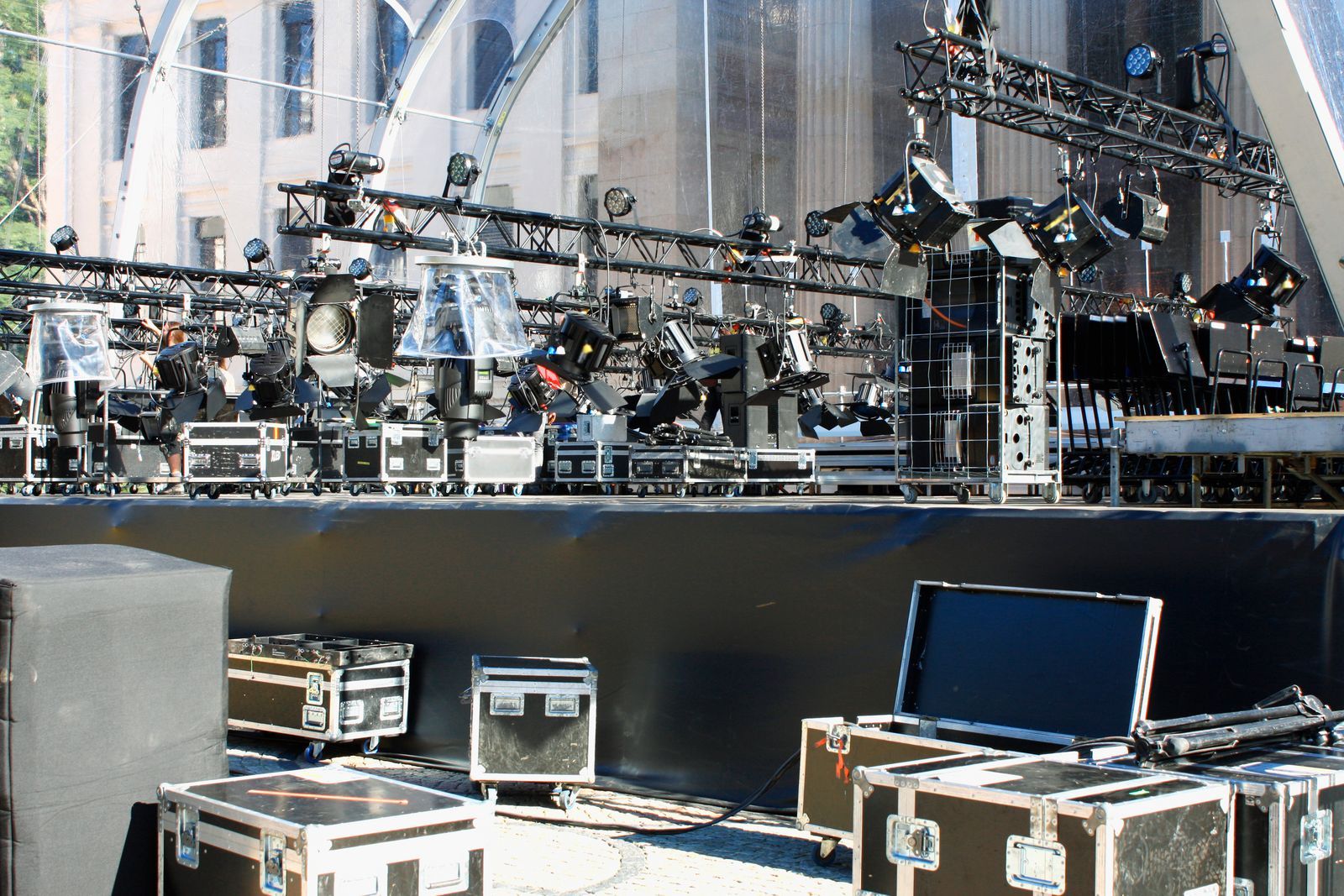
Stage instruments
Backline rental for concerts and live shows
Drum kit, guitar and bass amps, keyboards and everything a band needs to find set up when it walks on stage, especially when several bands play in one night.
- Includes
- Drums and amplification
- Use
- Concerts and festivals
- Set-up
- Included
- Area
- Seville and province
What backline is
Literally, what sits behind the musician
Backline is all the stage instrumentation that is not part of the sound system: drum kit, amplifiers, keyboards, music stands and the stands that hold them.
A band can bring its personal instruments — guitars, basses, cymbals, snare drums, pedals — and find the heavy, shared gear already on stage: the drum kit, the amps and the keyboards. That is backline. At festivals and multi-band nights, it is what makes changeovers between acts take minutes rather than an hour.
What is usually rented
- Complete drum kit with hardware, pedal, throne and rug. Drummers usually bring their own cymbals and snare.
- Guitar amplifier, with cabinet or combo, as specified in the rider.
- Bass amplifier with cabinet, or a direct line to the desk if the stage is small.
- Keyboard and stand, with sustain pedal and output to a DI box.
- Music stands, mic stands, stools and rugs, plus patch cables and DI boxes.
When renting makes sense
When the band is travelling and cannot bring heavy gear, when several bands share the same stage, when venue access makes loading difficult, or when the gig is somewhere you cannot spend two hours setting up. In all these cases, having the backline set up and tested before anyone arrives saves the part of the day that most easily gets out of hand.
How it is coordinated
The rider, the shared stage and changeovers between bands
If there is a rider, it sets out what the band expects to find. Our job is to tell you what we cover as specified, what we replace with a reasonable equivalent and what would need to be sourced separately. You almost never need to follow a rider to the letter: what matters is meeting its intent. If you find it confusing, here we explain how to read a technical rider without being a technician.
Shared stage
With several bands, what works is a shared backline — the drum kit and amps stay put — with each band swapping only its own gear: snare, cymbals, pedalboard and guitars. It is agreed with everyone in advance, and the stage is set with position marks so each changeover takes minutes. That agreement is settled at the production meeting, not on the afternoon of the gig.
What goes with the backline
Backline only makes sense with the rest of the stage in place: monitors so the musicians can hear themselves, microphones to pick up drums and amps, enough channels on the desk and a PA that matches the venue. And underneath it all, a stable stage or riser: a drum kit on a floor that moves is a problem all night long.
Beware of the makeshift stage
Amps pointing straight at the back of the singer's head bleed into every microphone and force the front-of-house level up. Angling them slightly or raising them to the musician's ear height lets you lower the stage volume, and that improves the sound in the room more than any EQ.
What's included
How we deliver the backline
Drum kit set up and tuned
We deliver it assembled, with heads in good condition and tuned. The drummer adjusts it to taste during the sound check.
Checked amplification
All gear is tested before it is loaded. An amp that hums on stage ruins a live show.
Position marks
On shared stages we mark where everything goes so changeovers are quick.
Cabling and DI included
Patch cables, extension leads, DI boxes and protected power strips — the things that are always missing.
Coordination with production
We talk to whoever runs the line-up to agree the shared backline and the changeover order.
Optional stage technician
Someone on hand to fix whatever breaks or gets moved between bands.
Reference
What is usually needed
| Format | Backline | Note |
|---|---|---|
| Solo artist or acoustic duo | Keyboard or small amp, music stands and stools | Minimal set-up |
| Pop or rock band | Drum kit, guitar amp and bass amp | Most popular |
| Band with keyboards | All of the above plus keyboard, stand and DI | Extra channels on the desk |
| Multi-band line-up | Shared common backline | Position marks and quick changeovers |
| Flamenco ensemble | Guitar amplification, stools and tablao (flamenco dance platform) | Specialised microphones |
Related equipment
The complete stage
Backline is one layer. These are the other pieces of a live set-up.
Frequently asked questions
Backline FAQs
Does the drum kit include cymbals and snare?
Usually not: most drummers prefer to bring their own, as they are the most personal part of the instrument. If the band cannot bring them, mention it when you request your quote and we will have them ready.
Can you cover my band's rider?
Send it to us and we will reply point by point: what we have as specified, what we replace with an equivalent and what would need to be sourced elsewhere. Much better to know two weeks before than on the afternoon of the gig.
Can several bands share the backline?
Yes, and it is what we recommend for multi-band line-ups. You agree beforehand what stays fixed and what each band swaps, so changeovers take minutes.
Do you set up the stage as well?
Yes, we set up risers or a modular stage, structure and sound. All from the same truck and with the same crew: see stages and risers.
Do I need a stage technician?
For a single-band gig, not always. For a multi-band line-up with quick changeovers, yes: it is the difference between running to schedule and finishing late.
Equipment
The equipment, set up and cabled
This is the equipment this page talks about, and how it looks once it is set up.
Got a concert to produce?
Send us the line-up and the rider and we will put together backline, stage and sound in a single quote.
