
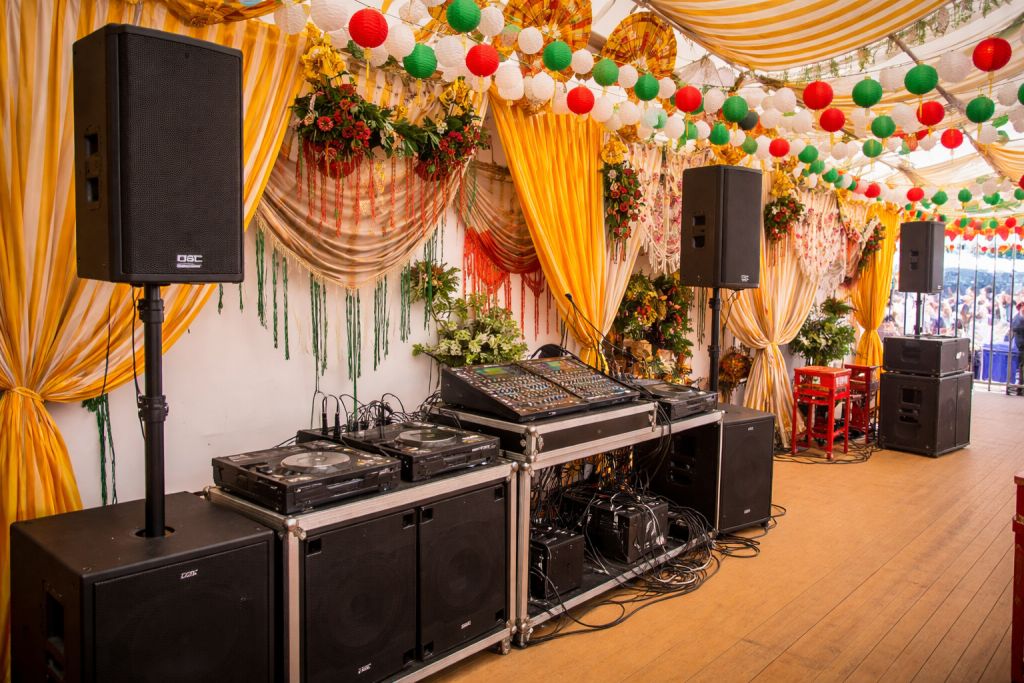
Seville · Feria
How to set up sound for a Feria caseta and live to tell the tale
A caseta (fair marquee) is a canvas tent with neighbours three metres away, constant background noise and an audience that sings along. It is one of the hardest set-ups of the year.
The problem
Everything that makes a caseta difficult, all at once
A caseta packs almost every possible acoustic problem into a few metres. The canvas insulates nothing: what plays inside can be heard outside and what plays in the caseta next door can be heard inside. The roof is low and flat, so sound bounces between the canvas and the albero (compacted sand) floor. Background noise is extremely high, because there are people talking, hand-clapping, singing and four other casetas all around. And the audience is standing, very close to the system and spread along a narrow, deep space.
On top of that, there are volume limits, neighbours trying to sleep and set hours. The upshot is that turning up the volume (the instinctive reaction) is almost always the worst possible decision.
The real goal
It isn't about being loud: it is about sounding the same from the entrance to the back, at a level that lets people talk at the tables and doesn't spill out into the street. You achieve that through distribution and placement, not power.
The set-up
How it is solved in practice
Spread it across several small points
Instead of two large speakers at the back, four or six small speakers spread along the caseta at a low level. It evens out the coverage, lowers the peak level and greatly reduces what escapes through the canvas.
Mount them high and angled down
Speakers at head height get absorbed by the front row. Raised and tilted towards the audience, they cover far better and avoid firing at the side canvas.
Keep the bass under control
Bass goes straight through the canvas and reaches people's homes. Use just enough subwoofer, placed on the floor and facing inwards, never pointing at the street or the neighbours.
Separate the dance area from the tables
Even if the caseta is small, aiming the sound reinforcement at the dance floor and keeping the table area at a lower level lets people stay all night without leaving.
Plan the microphones
Almost every caseta has a performance, a presentation or someone singing. A couple of microphones with their channel ready avoids the classic "pass me the karaoke one" at two in the morning.
Run cables with the albero floor in mind
All cabling protected and out of the way. In a packed caseta, a loose cable means an accident and a guaranteed music cut-out.
Regulations
What the Real (fairground) and the city council may require
Disclaimer. This article is for general guidance and information only. It is not legal advice. Specific obligations depend on the municipality, the type of activity and each individual application, so before finalising anything, check your local council's bylaw or ask directly at the department that processes the permit.
The rules for a caseta depend on the regulations each city council approves for its fair and on the venue's own bylaws. There may be emission limits, hours when music is allowed, electrical installation requirements and, in many cases, a mandatory sound limiter.
The practical thing is to ask the caseta committee or the city council before setting up, because these conditions are known in advance and they change the technical approach. If there is a limiter, the system isn't sized by maximum power but by the real ceiling available, and that is where spreading the sound across several points again proves the best tool: the same perceived sound with a lower level at the measuring point.
The general noise framework, with its three layers of regulation, is explained in noise regulations for events. And if the caseta or venue belongs to a town fair with activity on the public street, it is also worth looking at permits for street events.
Logistics
The quirks of setting up at the Real (fairground)
Very strict set-up windows
Vehicle access to the fairground is regulated and limited to specific days and times. If you miss your window, there isn't a second one.
Albero and dust
The equipment takes a beating. It is protected, raised off the ground where possible and cleaning is planned for. That isn't a complaint: it is a real chunk of time.
Shared power supply
The caseta powers the kitchen, bar, lighting and sound from the same installation. The sound should have its own line: how to work it out is explained in this power consumption guide.
Heat
In a closed caseta full of people, the temperature climbs a lot. The equipment needs ventilation and can't be shut away behind a curtain.
The whole week blocked out
The equipment doesn't return to the warehouse until the fair is over. That is why it is booked well in advance: we explain it in this booking timeline guide.
Collection at closing time
Take-down also has its own time window and its own queue of vehicles. It should be factored into the quote from the start.
Keep reading
Related links
Frequently asked questions
Questions about casetas
How many speakers does a caseta need?
More than people think, but smaller ones. The key isn't power but distribution: several points along the caseta sound better and cause less disturbance than two large speakers at the back.
Does a caseta need a subwoofer?
If there will be dancing, yes, but in moderation and properly aimed. Bass is what escapes most through the canvas and what generates the most complaints outside.
Can we have sevillanas and then dance music with the same system?
Yes. What changes is the tuning and the level, not the equipment. Having a microphone channel ready from the start makes the transition between sets much easier.
When should I book sound for the caseta?
Well in advance. The equipment is tied up for the whole Feria week, so availability runs out much sooner than for any other date in the year.
Can you set up before the alumbrao (opening night)?
Yes, that is the norm. Set-up takes place within the fairground access window, which is regulated and limited, so it is planned with the caseta committee.
Got a caseta this year?
Tell us the size and what will be happening inside, and we'll prepare the complete set-up.
