
Regulations · For guidance only
Simultaneous Interpretation in Seville: A Guide for Congresses
Three levels of rules, a local council that decides and a neighbour who can call. Here's what to know before hiring music for an event in Seville.
The framework
Three layers of rules that apply at the same time
If you are organising a conference, a professional seminar or an event with delegates from several countries, simultaneous interpretation equipment in Seville lets everyone follow the talk in their own language without interrupting the speaker. This guide explains, without jargon, which components are involved, what you need to decide before requesting a quote and which mistakes to avoid.
How does simultaneous interpretation work at an event?
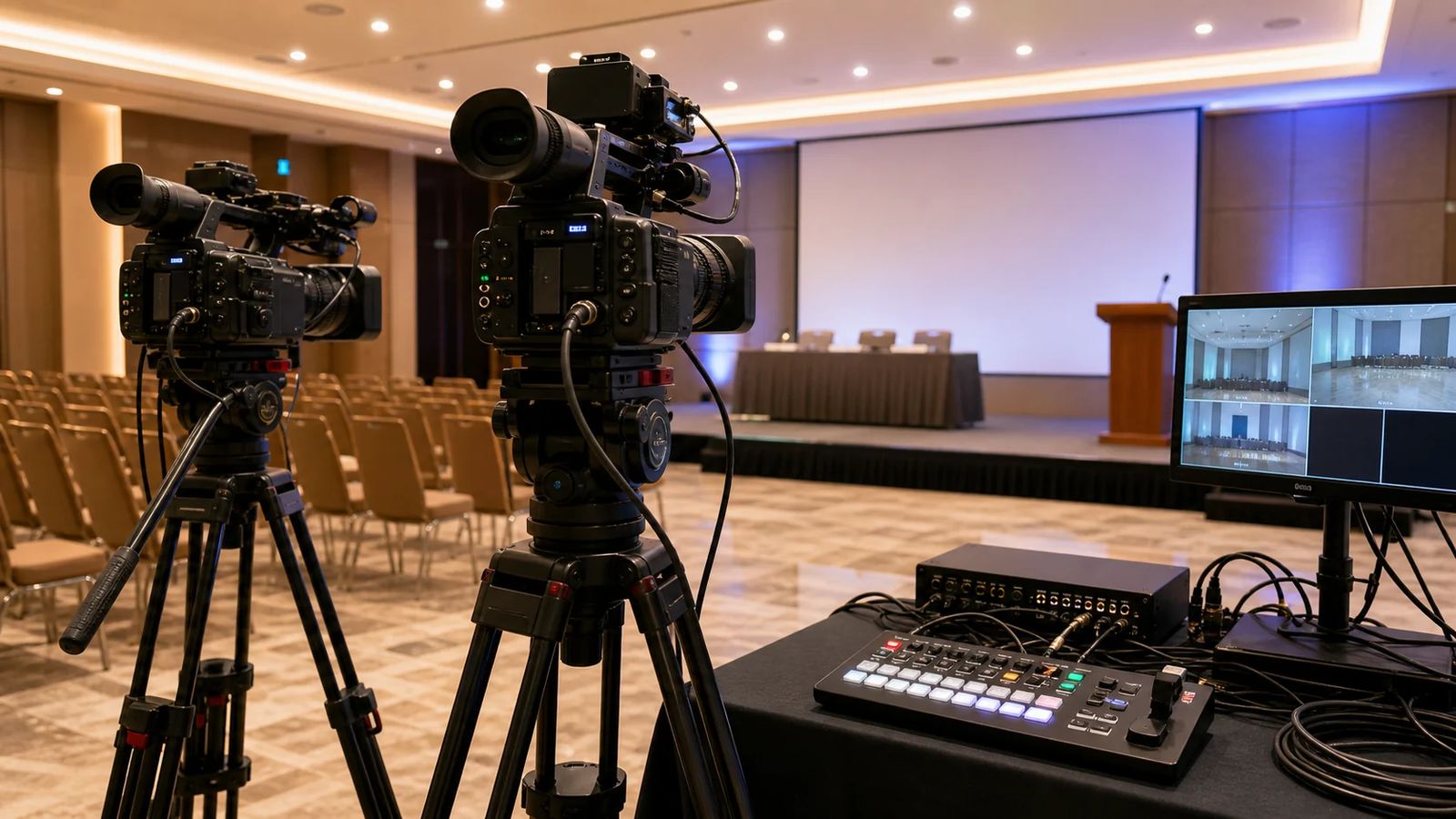
The principle is simple: the speaker talks, an interpreter translates almost at the same time and each delegate listens through headphones. To make it work, you need several components working together:
- Interpreting booth: the space where the interpreter works, isolated from the noise of the room.
- Interpreter equipment: a microphone and headphones to hear the speaker clearly and transmit the interpretation.
- Channel transmission: the system that sends each language to the delegates.
- Receivers and headphones: used by the audience to choose the language they want to hear.
- Room sound: the speaker's audio has to reach the interpreter and the rest of the audience cleanly.
If you want to see how we approach this service, you will find all the information on our page about simultaneous interpretation equipment and booths in Seville.
What should you decide before requesting a quote?
The more information you give us, the more accurate the quote will be. These are the details that help us most:
- Languages required: how many and which ones. Each language usually needs its own listening channel.
- Number of delegates who will need headphones: it is not always the full audience. Being clear on this avoids running short or paying for more than you need.
- Venue and room: hotel, conference centre, institutional building, outdoor space… The room determines where the booth can be placed.
- Date and times: including set-up and testing time before the delegates arrive.
- Event format: presentations, round tables, audience Q&A or two-way interpretation.
With these details you can also use our event planner to start preparing your request.
What sound does a room with simultaneous interpretation need?
Interpretation depends on the source audio. If the interpreter cannot hear the speaker properly, the quality of the interpretation drops, however good the interpreting equipment may be. That is why it pays to think about the whole system:
- Reliable microphones for speakers, moderators and audience questions.
- A clean mix, with no feedback and no areas of the room where the sound gets lost.
- A clear link between the room audio and the booth audio.
If your event is formal, with a lectern, a top table and speeches, you will find our page on sound for official and institutional events in Seville useful. And if your speakers need to move around the room, wireless microphones go a long way towards keeping things natural.
What are the most common mistakes when hiring simultaneous interpretation?
- Leaving it until the last minute. This service needs planning. The sooner you tell us the date and venue, the better we can organise it.
- Confusing equipment with interpreters. Renting booths and receivers is one thing; having professional interpreters is another. Always check what your quote includes and who is responsible for each part.
- Not visiting or getting to know the room. A booth needs a spot with a good view of the stage and screens. Send us photos or a floor plan of the room.
- Forgetting the technician. The technician who runs the system during the event is quoted separately from the equipment rental. It is best to include it from the outset so there are no surprises.
- Not planning for visual material. If there are presentations, the interpreters need to see the screen. For events with projection, see our projection screen rental in Seville.
What does our service include in Seville and province?
We work in Seville city and province, and equipment rental is offered as a complete service: transport, set-up and sound check. That way, on the day of the event the system is ready before the doors open. Exactly what is included in each case (number of booths, receivers, channels) is detailed in the quote according to your event, and the technician is listed as a separate item.
It is a solution designed for conferences, professional seminars, official events and gatherings with an international audience, whether in hotels and venues in the city or in towns across the province.
Frequently asked questions
Do I need simultaneous interpretation, or is consecutive enough?
With simultaneous interpretation, the translation is heard almost at the same time as the speech, with no pauses. With consecutive interpretation, the speaker stops so the interpreter can translate. Simultaneous saves time at long conferences with several speakers; consecutive may work for short events or small meetings.
Do you need a booth for each language?
It depends on the language combination and how the interpreters organise their work. Tell us the languages and the event format and we will reflect it in the quote.
Can headphones be used for the whole audience?
Yes, but it is not always necessary. The usual approach is to work out how many delegates will need the interpretation and size the number of receivers accordingly, rather than on the total capacity.
Is the technician included in the rental?
No. The technician is quoted separately. We show this clearly in the quote so you know from the start which part covers the equipment and which covers staff.
Get a quote for your conference in Seville
Tell us the date, venue, languages and number of delegates, and we will prepare a clear proposal, including transport, set-up and sound check, with no surprises. You can contact us via the website form, by phone or on WhatsApp. If you would rather see the other options first, visit the Alquiler Sonido Sevilla home page.
What changes from case to case
Five variables that determine what will be required of you
Where the event is
An industrial estate is not the same as a residential street or an area declared acoustically saturated. The area's classification determines the permitted levels.
Indoors or outdoors
An enclosed, soundproofed venue is assessed by what it transmits outside and to the neighbours. An outdoor event can't be soundproofed: there it's regulated by hours, distance and emission limits.
The time
Practically all bylaws distinguish between daytime, evening and night-time periods, with stricter limits at night. The night-time step-down is what catches most events off guard.
The type of activity
An authorised one-off activity, a patron saint festival, a fair caseta (fair marquee) or a venue with a music licence each fall under different regimes. Some cases have specific treatment provided for precisely because they are exceptional.
Whether there's an audience and ticket sales
An event being private and closed doesn't exempt you from noise regulations, but it does change the type of authorisation you need and who is responsible for applying for it.
In practice
What happens if a neighbour calls the local police
The typical scenario is this: someone calls, the local police turn up and assess the situation. From there, several things can happen depending on the municipality and the case: a verbal request to turn the volume down, a measurement if they're equipped and the procedure allows it, a report recording the facts, or outright cessation of the activity if it isn't authorised.
What almost always makes the difference is not the exact level, but whether or not the activity is authorised. An authorised event that goes over the volume limit usually ends with a warning and turning it down. An unauthorised event with music in a public space may be shut down early. That is why permits and noise are really the same issue, even though they are handled by different offices: we explain it in permits for events in public spaces.
The penalty regime
Offences are classified by severity and carry penalties set by the regulations themselves, as well as measures such as sealing equipment or suspending the activity. The specific amounts and offence types depend on the applicable rules and the municipality, so you won't find a figure here: it's in the text of the relevant bylaw.
Who is responsible
Another common question: responsibility normally lies with the holder of the activity licence or the event organiser, not with the company renting out the equipment. We can set up the system to the limit you give us, install and respect a sound limiter and advise you on positioning, but the permit is the organiser's responsibility.
Prevention
How to reduce the problem through the set-up
Ask the venue before booking
Many estates, halls and casetas already know exactly what they're allowed and until what time, because they've been through it before. It's the quickest source of information there is.
Check the bylaw of the specific municipality
Not the City of Seville's if the event is in Utrera. Each council publishes its own, and the environment or festivities department can answer questions.
Spread the sound rather than concentrating it
Four low-level reinforcement points cover the same area as two speakers at high level and generate far lower peak levels in the surroundings. It's the most effective measure and the least applied.
Watch where the bass is pointing
Bass is what passes through walls and what triggers the calls. Pointing the system towards where there are no neighbours, rather than towards the street, completely changes the outcome.
Plan for the night-time level drop
If you know that at a certain time the volume has to come down, build that moment into the event running order instead of cutting the music abruptly mid-song.
Talk to the neighbours if the event is in a street or courtyard
It's not a legal requirement, but advance notice prevents half of the noise complaints from one-off events.
Keep reading
Related links
Frequently asked questions
Questions about noise and events
How many decibels can I play at my event?
There's no universal figure. It depends on the municipality, the acoustic zone the venue is in, the time of day and the type of authorised activity. The local bylaw sets it, which is why we recommend checking it or asking the council directly.
Do noise regulations apply if the event is private?
Noise regulations protect neighbours; they don't care how nice the event is. Being private changes the type of authorisation you need, not the obligation not to cause disturbance beyond what is permitted.
How late can I have music?
The municipal bylaw sets it, usually with different hours on weekdays and at weekends, and special arrangements for local festivities. Ask before fixing the DJ's hours, not afterwards.
Can my equipment be sealed off?
The rules provide for interim measures such as suspending the activity or sealing equipment in certain cases. It's rare at authorised events and much more likely when there is no authorisation.
Is the sound company responsible?
Responsibility for the authorisation and for compliance lies with the organiser or holder of the activity. We set up within the limit we're given and can install a sound limiter, but we can't authorise an event.
Does your event have a noise limit?
Tell us what the council or the venue has told you and we'll size the system to comply.
