
Booking
How to choose the perfect DJ for your event in Seville
A good DJ is not the one who mixes best: it is the one who reads the dance floor and knows what to play at a quarter past two. These are the criteria that genuinely predict how the night will go.
The starting point
Technical skill is what least sets an event DJ apart
Almost any professional DJ can mix. What separates a night that works from one that falls flat is reading the room: noticing the dance floor is emptying two songs before it empties, knowing when to slow the pace so people can catch their breath and when to lift it again, and not dropping their own favourite track just because they feel like it.
You won't see that in a demo. You see it by asking about events similar to yours and listening to how they answer. A DJ used to weddings will talk to you about the change in energy after dinner; one used to clubs will talk to you about their style. Both can be good, but not for the same thing.
The five criteria
What to look for, in order of importance
Experience at events like yours
A wedding is not the same as a nightclub, a conference or a caseta. At a wedding there is a ceremony, protocol, guests from three generations and set moments; in a club there is a dance floor and a peak hour. Ask about specific events of the same type and how they handled the transition between sections.
A versatile, personalised repertoire
The music list is agreed beforehand, not on the night. A good professional will ask you for a must-play list and a do-not-play list, and will make it clear that within those limits the call is theirs. Be as wary of one who accepts a fixed four-hour playlist as of one who accepts no direction at all.
A sound system that matches the venue
Many DJs bring a booth but no PA, or bring a PA designed for a hundred people when your event has three hundred. Be clear about who provides what. If you are supplying the equipment, make sure the DJ booth is the one they normally use: the event is not the day to learn a new player.
Verifiable references
Videos of real events, not just edited clips with music laid over them. And, if possible, the contact of someone who hired them for something similar. In Seville the industry is small: asking the venue or the caterer who they have worked well with usually gives better information than any website.
Full service or clear coordination
If the DJ, sound, lighting and stage come from different suppliers, someone has to coordinate set-up times, power and space. Either you do it, or you hire someone who brings it all together. It is the difference between one phone call and five.
Before you sign
Questions that save headaches
What equipment do you bring and what do you expect to find there? This is the question that avoids the most problems. Many DJs assume there will be a table, monitors or a power socket next to the booth, and then it turns out there isn't.
What time do you need to set up and soundcheck? A DJ who arrives fifteen minutes before starting won't be able to adjust anything. And if they share the space with the sound technician, the two set-ups have to fit together.
What happens if we run over time? It is normal for the party to run late. It is just as normal that nobody has discussed the price of overtime. It is best to agree it in writing, together with the take-down time.
Does the venue have a sound limiter? If it does, the DJ needs to know in advance. A professional used to limiters works with headroom; one who isn't expecting it spends the whole night fighting the cut-outs. We explain it in our article on the sound limiter.
Who handles the music copyright? At events open to the public, the playlist usually has to be declared. In SGAE and copyright we explain how it works and when it applies.
System
What a DJ booth needs technically to work properly
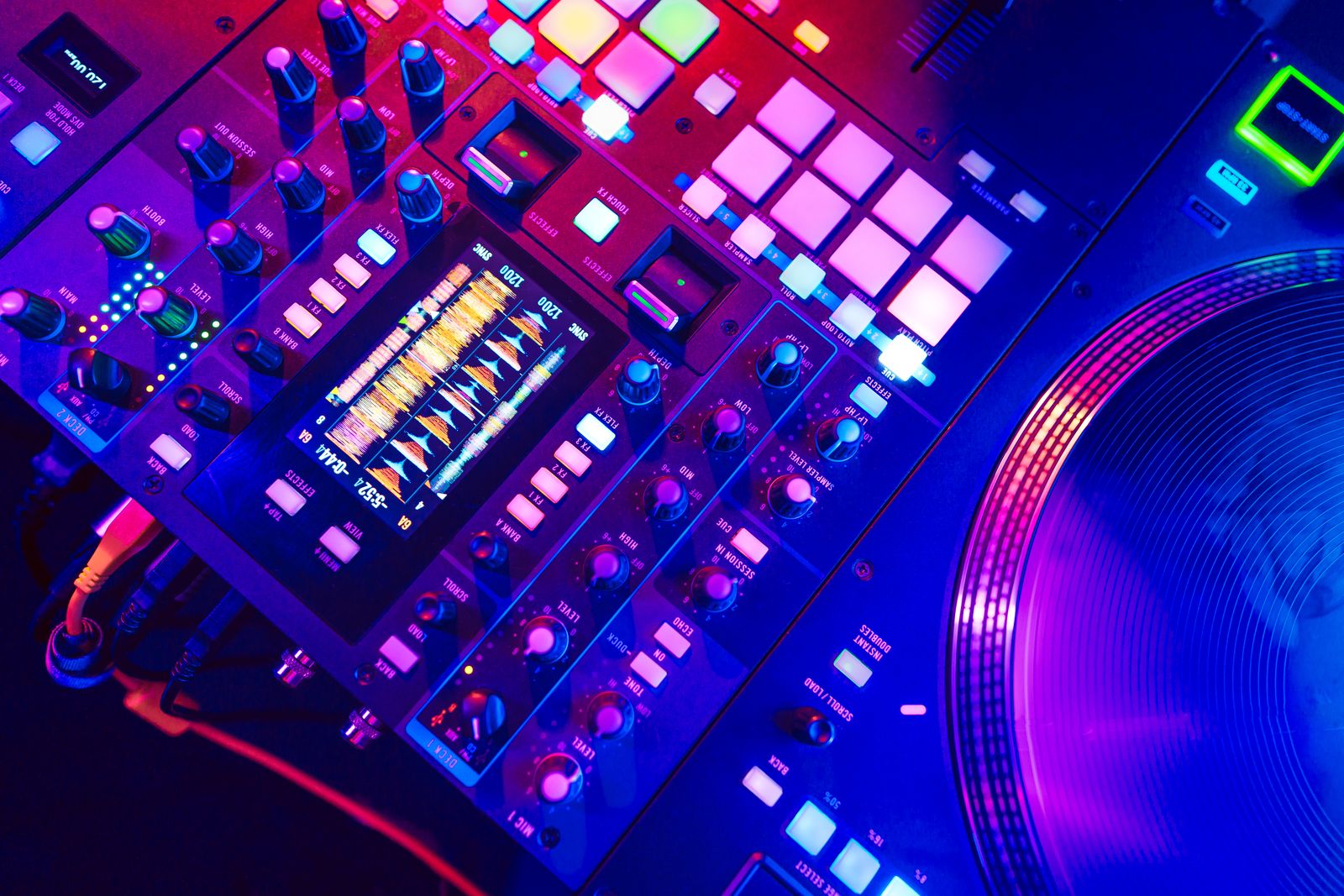
The standard set-up at events is a pair of players and a DJ mixer. Most professionals work on Pioneer CDJs because they are found almost everywhere and require no adjustment. For lighter set-ups, an all-in-one system cuts down on cabling and set-up time without sacrificing performance.
Beyond that, three things are often forgotten: a booth monitor so the DJ can hear themselves without relying on the PA, a sturdy table or surface at the right height —a wobbly catering table can ruin a set— and a dedicated, stable power supply, not shared with the smoke machine and the deep fryer.
The PA is separate. Depending on the number of guests and the space, it will be a pair of active speakers with subwoofers, or a larger system. How to size it is explained in this power guide. And if you also want lighting to go with the set, there are LED spotlights, moving heads and the LED dance floor.
Keep reading
Useful links
Frequently asked questions
Questions about hiring a DJ
Do you provide the DJ or just the equipment?
We work with DJs for events and we also rent just the equipment if you already have your own DJ. Most often clients ask us for the DJ booth and the PA, and bring their own DJ.
Can the DJ use a laptop instead of CDJs?
Yes, as long as we're told in advance. It changes the cabling, and sometimes an interface or a specific input on the mixer is needed. It's not a technical problem; it's a matter of letting us know.
How many hours does a set usually last?
It depends on the event and is agreed in the contract. The key is to agree beforehand on the price of any extra hour and how late the venue or local council regulations allow music to play.
Is a booth monitor needed if there are already speakers?
Yes. The DJ hears the PA with a delay and from a poor position. Without a monitor, they mix blind and end up turning up the overall volume to hear themselves.
Do you need a DJ booth, a PA or both?
Tell us the number of guests and the venue, and we'll prepare the complete set-up for you, installed and tested.
